mirror of
https://github.com/bevyengine/bevy.git
synced 2026-07-01 08:12:51 -04:00
create-pull-request/patch
62 Commits
| Author | SHA1 | Message | Date | |
|---|---|---|---|---|
 ickshonpe ickshonpe
|
b00ff93c87 |
Remove new_with_ prefix from the TextLayout constuctor functions (#24049)
# Objective Remove the `new_with_` prefixes from the `TextLayout` constuctor functions. Generally, the "new" part is redundant and "with" is used by fluent APIs. ## Solution Just delete the prefixes, shorten the names (all on `TextLayout`). * `new_with_justify` -> `justify` * `new_with_linebreak` -> `linebreak` * `new_with_no_wrap` -> `no_wrap` |
||
|
Talin
|
24661940b4 |
Rename examples/games to examples/showcase (#23375)
# Objective - Rename the `examples/games` directory to `examples/showcase`. The "showcase" category is used for examples that are more comprehensive and full-featured than most, but which are not necessarily games. |
||
|
ickshonpe
|
6ca4769128 |
Minimal responsive FontSize support (#22614)
# Objective

Add responsive font sizes supporting rem and viewport units to
`bevy_text` with minimal changes to the APIs and systems.

## Solution

Introduce a new `FontSize` enum:

```rust
pub enum FontSize {
    /// Font Size in logical pixels.
    Px(f32),
    /// Font size as a percentage of the viewport width.
    Vw(f32),
    /// Font size as a percentage of the viewport height.
    Vh(f32),
    /// Font size as a percentage of the smaller of the viewport width and height.
    VMin(f32),
    /// Font size as a percentage of the larger of the viewport width and height.
    VMax(f32),
    /// Font Size relative to the value of the `RemSize` resource.
    Rem(f32),
}
```

This replaces the `f32` value of `TextFont`'s `font_size` field.

The viewport variants work the same way as their respective `Val`
counterparts.

`Rem` values are multiplied by the value of the `RemSize` resource
(which newtypes an `f32`).

`FontSize` provides an `eval` method that takes a logical viewport size
and rem base size and returns an `f32` logical font size. The resolved
logical font size is then written into the `Attributes` passed to Cosmic
Text by `TextPipeline::update_buffer`.

Any text implementation using `bevy_text` must now provide viewport and
rem base values when calling `TextPipeline::update_buffer` or
`create_measure`.

`Text2d` uses the size of the primary window to resolve viewport values
(or `Vec2::splat(1000)` if no primary window is found). This is a
deliberate compromise, a single `Text2d` can be rendered to multiple
viewports using `RenderLayers`, so it's difficult to find a rule for
which viewport size should be chosen.

### Change detection

`ComputedTextBlock` has two new fields: `uses_viewport_sizes` and
`uses_rem_sizes`, which are set to true in `TextPipeline::update_buffer`
iff any text section in the block uses viewport or rem font sizes,
respectively.

The `ComputedTextBlock::needs_rerender` method has been modified to take
take two bool parameters:
```rust
    pub fn needs_rerender(
        &self,
        is_viewport_size_changed: bool,
        is_rem_size_changed: bool,
    ) -> bool {
        self.needs_rerender
            || (is_viewport_size_changed && self.uses_viewport_sizes)
            || (is_rem_size_changed && self.uses_rem_sizes)
    }
 ```
This ensures that text reupdates will also be scheduled if one of the text section's uses a viewport font size and the local viewport size changed, or if one of the text section's uses a rem font size and the rem size changed.

#### Limitations

There are some limitations because we don't have any sort of font style inheritance yet:

* "rem" units aren't proper rem units, and just based on the value of a resource.
* "em" units are resolved based on inherited font size, so can't be implemented without inheritance support.

#### Notes

* This PR is quite small and not very technical. Reviewers don't need to be especially familiar with `bevy_text`. Most of the changes are to the examples.

* We could consider using `Val` instead of `FontSize`, then we could use `Val`'s constructor functions which would be much nicer, but some variants might not have sensible interpretations in both UI and Text2d contexts. Also we'd have to make `Val` accessible to `bevy_text`.

## Testing

The changes to the text systems are relatively trivial and easy to understand.  I already added a minor change to the `text` example to use `Vh` font size for the "hello bevy" text in the bottom right corner. If you change the size of the window, you should see the text change size in response. The text initially flickers before it updates because of some unrelated asset/image changes that mean that font textures aren't ready until the frame after the text update that changes the font size.

Most of the example migrations were automated using regular expressions, and there are bound to be mistakes in those changes. It's infeasible to check every single example thoroughly, but it's early enough in the release cycle that I don't think we should be too worried if a few bugs slip in.

---------

Co-authored-by: Kevin Chen <chen.kevin.f@gmail.com>
|
||
|
ickshonpe
|
e5d4dfd7a6 |
Minimal Font Families, Font Queries, Collections, System Fonts, Stretch, and Slant support (#22156)
# Objective

Implement support for the remaining missing text features with minimal
changes.

## Solution

`TextFont` has been expanded to include new fields:
```rust
pub struct TextFont {
    pub font: FontSource,
    pub font_size: f32,
    pub weight: FontWeight,
    pub width: FontWidth,
    pub style: FontStyle,
    pub font_smoothing: FontSmoothing,
    pub font_features: FontFeatures,
}
```

FontSource has two variants: Handle, which identifies a font by asset
handle, and Family, which selects a font by its family name.

`FontWidth` is a newtype struct representing OpenType font stretch
classifications ranging from ULTRA_CONDENSED (50%) to ULTRA_EXPANDED
(200%).

`FontStyle` is an enum used to set the slant style of a font, either
`Normal`, `Italic`, or `Oblique`.

The system font support is very barebones. You load them using the
`CosmicFontSystem` resource:
```rust
font_system.db_mut().load_system_fonts()
```
Then they are available to be selected by family name using
`FontSource::Family`.

### Other changes

* `TextPipelines`'s `glyph_info` field has been removed. There is no
need to collect the section infos or perform any querys during text
layout updates, so that code has been removed as well.

* `update_text_layout_info` used some `try_for_each` with some nested
closures which was unnecessarily complicated again. They've been
replaced with a regular for loop.

* After font assets are loaded there's a new system
`load_font_assets_into_fontdb_system` that automatically adds them to
cosmic text's font database. Then they are available to be looked up by
family name as well as by asset handle.

* There aren't are performance motivated changes but layout updates seem
to be overall significantly more efficient now, with a slight regression
for very large numbers of short, single section text entities.

* Font texture atlases are no longer automatically cleared when the font
asset they were generated from is removed. There is no way to remove
individual fonts from cosmic text's `FontSystem`, so the font is still
accessible using the family name with `FontSource::family` and removing
the text atlases naively could cause a panic since rendering expects
them to be present.

## Testing

```
cargo run --example font_query
```
---

## Showcase

<img width="1229" height="591" alt="font-query"
src="https://github.com/user-attachments/assets/23f5aaa2-fdb8-4448-9b4e-9d65d6431107"
/>

---------

Co-authored-by: Thierry Berger <contact@thierryberger.com>
|
||
|
ickshonpe
|
d5a16b7252 |
Text underline (#21559)
# Objective Text Underline ## Solution New `Underline` marker component, add to text entities to draw an underline. This PR is based on #21555, that should probably be reviewed and merged first. |
||
|
Janis
|
62270640e6 |
convert more examples to new spawn api (#20876)
# Objective works on #18238 ## Solution convert calls to `.with_children` to use the `Children::spawn` or `Children::spawn_one` types or `children!` macro. This touches the `window`, `2d`, `animation` folders, as well as `ecs/one_shot_systems.rs`. `observer_propagation.rs` looks like exactly what `with_children` is useful for, so I deliberately haven't touched it. I can break this up into more PRs or squash if desired. ## Testing I've run the examples before and after this patch and verified visually that nothing has changed |
||
|
ickshonpe
|
21dbf59a4d |
Move text2d into bevy_sprite (#20594)
# Objective Fixes #19531 ## Solution Move the `text2d` module from `bevy_text` into `bevy_sprite` Move the `text2d` rendering module from `bevy_ui_render` to `bevy_sprite_render`. Remove the `bevy_sprite`, `bevy_window`, `bevy_camera` and `bevy_transform` dependencies from `bevy_text`. ## Testing ``` cargo run --example text2d ``` ## Showcase |
||
|
ickshonpe
|
68aebf358c |
Text2d TextBackgroundColor support (#20464)
# Objective Add support for `TextBackgroundColor` to `Text2d`. ## Solution Add a `TextBackgroundColor` query to `extract_text2d_sprite` and queue a background sprite for each text section with a `TextBackgroundColor`. ## Testing Added `TextBackgroundColor`s to some of the text in the `text2d` example: ```cargo run --example text2d``` --- ## Showcase <img width="1924" height="1127" alt="text2d-background" src="https://github.com/user-attachments/assets/faa64dbe-cf80-4aca-b749-d24bb4399db3" /> |
||
|
ickshonpe
|
452b187f5f |
Text2d shadows (#20463)
# Objective Add support for shadows to `Text2d`. Fixes #19529 ## Solution * New `Text2dShadow` component. `Text2dShadow` has identical fields to `bevy_ui`'s `TextShadow`. Only the `Default` impl is different; since the y-axis is inverted for `Text2d`, the default y-offset needs to be negative. * `extract_text2d_sprite` now also draws shadow sprites when the `Text2dShadow` component is present. Unlike in the `bevy_ui` implementation, the shadows are extracted in the same system as the glyph sprites to ensure correct ordering. ## Testing Updated the `text2d` example to add some shadows to the text boxes: ``` cargo run --example text2d ``` ## Showcase <img width="1924" height="1127" alt="text-2d-shadows" src="https://github.com/user-attachments/assets/ba3c0ae3-a962-4a62-9cee-ea7e328cd80c" /> |
||
|
ickshonpe
|
02fa833be1 |
Rename JustifyText to Justify (#19522)
# Objective Rename `JustifyText`: * The name `JustifyText` is just ugly. * It's inconsistent since no other `bevy_text` types have a `Text-` suffix, only prefix. * It's inconsistent with the other text layout enum `Linebreak` which doesn't have a prefix or suffix. Fixes #19521. ## Solution Rename `JustifyText` to `Justify`. Without other context, it's natural to assume the name `Justify` refers to text justification. --------- Co-authored-by: Alice Cecile <alice.i.cecile@gmail.com> |
||
|
krunchington
|
5a9cb7de3e |
Update text2d example to use children macro (#18317)
# Objective Contributes to #18238 Updates the `text2d`, example to use the `children!` macro. I'm not sure I love the SpawnIter usage here, as I feel the `move` keyword in this case is subtle and error prone for those who lose fights with the borrow checker frequently (like me). Feedback very much welcome. ## Solution Updates examples to use the Improved Spawning API merged in https://github.com/bevyengine/bevy/pull/17521 ## Testing - Did you test these changes? If so, how? - Opened the examples before and after and verified the same behavior was observed. I did this on Ubuntu 24.04.2 LTS using `--features wayland`. - Are there any parts that need more testing? - Other OS's and features can't hurt, but this is such a small change it shouldn't be a problem. - How can other people (reviewers) test your changes? Is there anything specific they need to know? - Run the examples yourself with and without these changes. - If relevant, what platforms did you test these changes on, and are there any important ones you can't test? - see above --- ## Showcase n/a ## Migration Guide n/a |
||
|
ickshonpe
|
84b09b9398 |
Newtype Anchor (#18439)
# Objective The `Anchor` component doesn't need to be a enum. The variants are just mapped to `Vec2`s so it could be changed to a newtype with associated const values, saving the space needed for the discriminator by the enum. Also there was no benefit I think in hiding the underlying `Vec2` representation of `Anchor`s. Suggested by @atlv24. Fixes #18459 Fixes #18460 ## Solution Change `Anchor` to a struct newtyping a `Vec2`, and its variants into associated constants. ## Migration Guide The anchor component has been changed from an enum to a struct newtyping a `Vec2`. The `Custom` variant has been removed, instead to construct a custom `Anchor` use its tuple constructor: ```rust Sprite { anchor: Anchor(Vec2::new(0.25, 0.4)), ..default() } ``` The other enum variants have been replaced with corresponding constants: * `Anchor::BottomLeft` to `Anchor::BOTTOM_LEFT` * `Anchor::Center` to `Anchor::CENTER` * `Anchor::TopRight` to `Anchor::TOP_RIGHT` * .. and so on for the remaining variants |
||
|
Radislav Myasnikov
|
94e0e1f031 |
Updated the 2D examples to make them uniform (#17237)
# Objective Make the examples look more uniform and more polished. following the issue #17167 ## Solution - [x] Added a minimal UI explaining how to interact with the examples only when needed. - [x] Used the same notation for interactions ex : "Up Arrow: Move Forward \nLeft / Right Arrow: Turn" - [x] Set the color to [GRAY](https://github.com/bevyengine/bevy/pull/17237#discussion_r1907560092) when it's not visible enough - [x] Changed some colors to be easy on the eyes - [x] removed the //camera comment - [x] Unified the use of capital letters in the examples. - [x] Simplified the mesh2d_arc offset calculations. ... --------- Co-authored-by: Alice Cecile <alice.i.cecile@gmail.com> Co-authored-by: Rob Parrett <robparrett@gmail.com> |
||
|
ickshonpe
|
3f99a3e8cd |
Text 2d alignment fix (#17365)
# Objective `Text2d` ignores `TextBounds` when calculating the offset for text aligment. On main a text entity positioned in the center of the window with center justification and 600px horizontal text bounds isn't centered like it should be but shifted off to the right: <img width="305" alt="hellox" src="https://github.com/user-attachments/assets/8896c6f0-1b9f-4633-9c12-1de6eff5f3e1" /> (second example in the testing section below) Fixes #14266 I already had a PR in review for this (#14270) but it used post layout adjustment (which we want to avoid) and ignored `TextBounds`. ## Solution * If `TextBounds` are present for an axis, use them instead of the size of the computed text layout size to calculate the offset. * Adjust the vertical offset of text so it's top is aligned with the top of the texts bounding rect (when present). ## Testing ``` use bevy::prelude::*; use bevy::color::palettes; use bevy::sprite::Anchor; use bevy::text::TextBounds; fn main() { App::new() .add_plugins(DefaultPlugins) .add_systems(Startup, setup) .run(); } fn example(commands: &mut Commands, dest: Vec3, justify: JustifyText) { commands.spawn(( Sprite { color: palettes::css::YELLOW.into(), custom_size: Some(10. * Vec2::ONE), anchor: Anchor::Center, ..Default::default() }, Transform::from_translation(dest), )); for a in [ Anchor::TopLeft, Anchor::TopRight, Anchor::BottomRight, Anchor::BottomLeft, ] { commands.spawn(( Text2d(format!("L R\n{:?}\n{:?}", a, justify)), TextFont { font_size: 14.0, ..default() }, TextLayout { justify, ..Default::default() }, TextBounds::new(300., 75.), Transform::from_translation(dest + Vec3::Z), a, )); } } fn setup(mut commands: Commands) { commands.spawn(Camera2d::default()); for (i, j) in [ JustifyText::Left, JustifyText::Right, JustifyText::Center, JustifyText::Justified, ] .into_iter() .enumerate() { example(&mut commands, (300. - 150. * i as f32) * Vec3::Y, j); } commands.spawn(Sprite { color: palettes::css::YELLOW.into(), custom_size: Some(10. * Vec2::ONE), anchor: Anchor::Center, ..Default::default() }); } ``` <img width="566" alt="cap" src="https://github.com/user-attachments/assets/e6a98fa5-80b2-4380-a9b7-155bb49635b8" /> This probably looks really confusing but it should make sense if you imagine each block of text surrounded by a 300x75 rectangle that is anchored to the center of the yellow square. # ``` use bevy::prelude::*; use bevy::sprite::Anchor; use bevy::text::TextBounds; fn main() { App::new() .add_plugins(DefaultPlugins) .add_systems(Startup, setup) .run(); } fn setup(mut commands: Commands) { commands.spawn(Camera2d::default()); commands.spawn(( Text2d::new("hello"), TextFont { font_size: 60.0, ..default() }, TextLayout::new_with_justify(JustifyText::Center), TextBounds::new(600., 200.), Anchor::Center, )); } ``` <img width="338" alt="hello" src="https://github.com/user-attachments/assets/e5e89364-afda-4baa-aca8-df4cdacbb4ed" /> The text being above the center is intended. When `TextBounds` are present, the text block's offset is calculated using its `TextBounds` not the layout size returned by cosmic-text. # Probably we should add a vertical alignment setting for Text2d. Didn't do it here as this is intended for a 0.15.2 release. |
||
|
theotherphil
|
e66aef2d7a |
Correct 'Text2dBundle' to 'Text2d' in example comment (#17425)
# Objective Update out of date comment. ## Solution ## Testing N/A |
||
|
ickshonpe
|
d34803f5f4 |
Add some multi-span text to the text2d example (#17308)
# Objective The `Text2d` example should have have some multi-span text. Co-authored-by: François Mockers <mockersf@gmail.com> |
||
|
Rob Parrett
|
5c0e13f29b |
Fix text alignment for unbounded text (#17270)
# Objective Fixes #16783 ## Solution Works around a `cosmic-text` bug or limitation by triggering a re-layout with the calculated width from the first layout run. See linked issue. Credit to @ickshonpe for the clever solution. ## Performance This has a significant performance impact only on unbounded text that are not `JustifyText::Left`, which is still a bit of a bummer because text2d performance in 0.15.1 is already not great. But this seems better than alignment not working. ||many_text2d nfc re|many_text2d nfc re center| |-|-|-| |unbounded-layout-no-fix|3.06|3.10| |unbounded-layout-fix|3.05 ⬜ -0.2%|2.71 🟥 -12.5%| ## Testing I added a centered text to the `text2d` example. `cargo run --example text2d` We should look at other text examples and stress tests. I haven't tested as thoroughly as I would like, so help testing that this doesn't break something in UI would be appreciated. |
||
|
andristarr
|
7482a0d26d |
aligning public apis of Time,Timer and Stopwatch (#15962)
Fixes #15834 ## Migration Guide The APIs of `Time`, `Timer` and `Stopwatch` have been cleaned up for consistency with each other and the standard library's `Duration` type. The following methods have been renamed: - `Stowatch::paused` -> `Stopwatch::is_paused` - `Time::elapsed_seconds` -> `Time::elasped_secs` (including `_f64` and `_wrapped` variants) |
||
|
ickshonpe
|
6f7d0e5725 |
split up TextStyle (#15857)
# Objective

Currently text is recomputed unnecessarily on any changes to its color,
which is extremely expensive.

## Solution
Split up `TextStyle` into two separate components `TextFont` and
`TextColor`.

## Testing

I added this system to `many_buttons`:
```rust
fn set_text_colors_changed(mut colors: Query<&mut TextColor>) {
    for mut text_color in colors.iter_mut() {
        text_color.set_changed();
    }
}
```

reports ~4fps on main, ~50fps with this PR.

## Migration Guide
`TextStyle` has been renamed to `TextFont` and its `color` field has
been moved to a separate component named `TextColor` which newtypes
`Color`.
|
||
|
UkoeHB
|
a6be9b4ccd |
Rename TextBlock to TextLayout (#15797)
# Objective - Improve clarity when spawning a text block. See [this discussion](https://github.com/bevyengine/bevy/pull/15591/#discussion_r1787083571). ## Solution - Rename `TextBlock` to `TextLayout`. |
||
|
UkoeHB
|
c2c19e5ae4 |
Text rework (#15591)
**Ready for review. Examples migration progress: 100%.** # Objective - Implement https://github.com/bevyengine/bevy/discussions/15014 ## Solution This implements [cart's proposal](https://github.com/bevyengine/bevy/discussions/15014#discussioncomment-10574459) faithfully except for one change. I separated `TextSpan` from `TextSpan2d` because `TextSpan` needs to require the `GhostNode` component, which is a `bevy_ui` component only usable by UI. Extra changes: - Added `EntityCommands::commands_mut` that returns a mutable reference. This is a blocker for extension methods that return something other than `self`. Note that `sickle_ui`'s `UiBuilder::commands` returns a mutable reference for this reason. ## Testing - [x] Text examples all work. --- ## Showcase TODO: showcase-worthy ## Migration Guide TODO: very breaking ### Accessing text spans by index Text sections are now text sections on different entities in a hierarchy, Use the new `TextReader` and `TextWriter` system parameters to access spans by index. Before: ```rust fn refresh_text(mut query: Query<&mut Text, With<TimeText>>, time: Res<Time>) { let text = query.single_mut(); text.sections[1].value = format_time(time.elapsed()); } ``` After: ```rust fn refresh_text( query: Query<Entity, With<TimeText>>, mut writer: UiTextWriter, time: Res<Time> ) { let entity = query.single(); *writer.text(entity, 1) = format_time(time.elapsed()); } ``` ### Iterating text spans Text spans are now entities in a hierarchy, so the new `UiTextReader` and `UiTextWriter` system parameters provide ways to iterate that hierarchy. The `UiTextReader::iter` method will give you a normal iterator over spans, and `UiTextWriter::for_each` lets you visit each of the spans. --------- Co-authored-by: ickshonpe <david.curthoys@googlemail.com> Co-authored-by: Carter Anderson <mcanders1@gmail.com> |
||
|
Emerson Coskey
|
7d40e3ec87 |
Migrate bevy_sprite to required components (#15489)
# Objective Continue migration of bevy APIs to required components, following guidance of https://hackmd.io/@bevy/required_components/ ## Solution - Make `Sprite` require `Transform` and `Visibility` and `SyncToRenderWorld` - move image and texture atlas handles into `Sprite` - deprecate `SpriteBundle` - remove engine uses of `SpriteBundle` ## Testing ran cargo tests on bevy_sprite and tested several sprite examples. --- ## Migration Guide Replace all uses of `SpriteBundle` with `Sprite`. There are several new convenience constructors: `Sprite::from_image`, `Sprite::from_atlas_image`, `Sprite::from_color`. WARNING: use of `Handle<Image>` and `TextureAtlas` as components on sprite entities will NO LONGER WORK. Use the fields on `Sprite` instead. I would have removed the `Component` impls from `TextureAtlas` and `Handle<Image>` except it is still used within ui. We should fix this moving forward with the migration. |
||
|
Joona Aalto
|
25bfa80e60 |
Migrate cameras to required components (#15641)
# Objective Yet another PR for migrating stuff to required components. This time, cameras! ## Solution As per the [selected proposal](https://hackmd.io/tsYID4CGRiWxzsgawzxG_g#Combined-Proposal-1-Selected), deprecate `Camera2dBundle` and `Camera3dBundle` in favor of `Camera2d` and `Camera3d`. Adding a `Camera` without `Camera2d` or `Camera3d` now logs a warning, as suggested by Cart [on Discord](https://discord.com/channels/691052431525675048/1264881140007702558/1291506402832945273). I would personally like cameras to work a bit differently and be split into a few more components, to avoid some footguns and confusing semantics, but that is more controversial, and shouldn't block this core migration. ## Testing I ran a few 2D and 3D examples, and tried cameras with and without render graphs. --- ## Migration Guide `Camera2dBundle` and `Camera3dBundle` have been deprecated in favor of `Camera2d` and `Camera3d`. Inserting them will now also insert the other components required by them automatically. |
||
|
UkoeHB
|
ead84e0e3d |
Rename BreakLineOn to LineBreak (#15583)
# Objective - Improve code quality in preparation for https://github.com/bevyengine/bevy/discussions/15014 ## Solution - Rename BreakLineOn to LineBreak. ## Migration Guide `BreakLineOn` was renamed to `LineBreak`, and paramters named `linebreak_behavior` were renamed to `linebreak`. |
||
|
Marco Buono
|
8e3db957c5 |
Add the ability to control font smoothing (#15368)
# Objective - Fixes #10720 - Adds the ability to control font smoothing of rendered text ## Solution - Introduce the `FontSmoothing` enum, with two possible variants (`FontSmoothing::None` and `FontSmoothing::AntiAliased`): - This is based on `-webkit-font-smoothing`, in line with our practice of adopting CSS-like properties/names for UI; - I could have gone instead for the [`font-smooth` property](https://developer.mozilla.org/en-US/docs/Web/CSS/font-smooth) that's also supported by browsers, but didn't since it's also non-standard, has an uglier name, and doesn't allow controlling the type of antialias applied. - Having an enum instead of e.g. a boolean, leaves the path open for adding `FontSmoothing::SubpixelAntiAliased` in the future, without a breaking change; - Add all the necessary plumbing to get the `FontSmoothing` information to where we rasterize the glyphs and store them in the atlas; - Change the font atlas key to also take into account the smoothing setting, not only font and font size; - Since COSMIC Text [doesn't support controlling font smoothing](https://github.com/pop-os/cosmic-text/issues/279), we roll out our own threshold-based “implementation”: - This has the downside of **looking ugly for “regular” vector fonts** ⚠️, since it doesn't properly take the hinting information into account like a proper implementation on the rasterizer side would. - However, **for fonts that have been specifically authored to be pixel fonts, (a common use case in games!) this is not as big of a problem**, since all lines are vertical/horizontal, and close to the final pixel boundaries (as long as the font is used at a multiple of the size originally intended by the author) - Once COSMIC exposes this functionality, we can switch to using it directly, and get better results; - Use a nearest neighbor sampler for atlases with font smoothing disabled, so that you can scale the text via transform and still get the pixelated look; - Add a convenience method to `Text` for setting the font smoothing; - Add a demonstration of using the `FontSmoothing` property to the `text2d` example. ## Testing - Did you test these changes? If so, how? - Yes. Via the `text2d`example, and also in my game. - Are there any parts that need more testing? - I'd like help from someone for testing this on devices/OSs with fractional scaling (Android/Windows) - How can other people (reviewers) test your changes? Is there anything specific they need to know? - Both via the `text2d` example and also by using it directly on your projects. - If relevant, what platforms did you test these changes on, and are there any important ones you can't test? - macOS --- ## Showcase ```rust commands.spawn(Text2dBundle { text: Text::from_section("Hello, World!", default()) .with_font_smoothing(FontSmoothing::None), ..default() }); ```  <img width="740" alt="image" src="https://github.com/user-attachments/assets/b881b02c-4e43-410b-902f-6985c25140fc"> ## Migration Guide - `Text` now contains a `font_smoothing: FontSmoothing` property, make sure to include it or add `..default()` when using the struct directly; - `FontSizeKey` has been renamed to `FontAtlasKey`, and now also contains the `FontSmoothing` setting; - The following methods now take an extra `font_smoothing: FontSmoothing` argument: - `FontAtlas::new()` - `FontAtlasSet::add_glyph_to_atlas()` - `FontAtlasSet::get_glyph_atlas_info()` - `FontAtlasSet::get_outlined_glyph_texture()` |
||
|
Benjamin Brienen
|
29508f065f |
Fix floating point math (#15239)
# Objective - Fixes #15236 ## Solution - Use bevy_math::ops instead of std floating point operations. ## Testing - Did you test these changes? If so, how? Unit tests and `cargo run -p ci -- test` - How can other people (reviewers) test your changes? Is there anything specific they need to know? Execute `cargo run -p ci -- test` on Windows. - If relevant, what platforms did you test these changes on, and are there any important ones you can't test? Windows ## Migration Guide - Not a breaking change - Projects should use bevy math where applicable --------- Co-authored-by: Alice Cecile <alice.i.cecile@gmail.com> Co-authored-by: IQuick 143 <IQuick143cz@gmail.com> Co-authored-by: Joona Aalto <jondolf.dev@gmail.com> |
||
|
Tero Laxström
|
522d82b21a |
Fixing text sizes for examples (#15190)
# Objective - Fixes #14265 ## Solution - Go through Pixel Eagle examples (and examples all in all) - If default size is used it is usually left there - If size of font is touched try dividing with 1.2 and round it to nearest whole number ## Testing - Run example before and after - Make sure examples text are readable or like before cosmic-text change --- ## Showcase Before:  After:  |
||
|
TotalKrill
|
5986d5d309 |
Cosmic text (#10193)
# Replace ab_glyph with the more capable cosmic-text Fixes #7616. Cosmic-text is a more mature text-rendering library that handles scripts and ligatures better than ab_glyph, it can also handle system fonts which can be implemented in bevy in the future Rebase of https://github.com/bevyengine/bevy/pull/8808 ## Changelog Replaces text renderer ab_glyph with cosmic-text The definition of the font size has changed with the migration to cosmic text. The behavior is now consistent with other platforms (e.g. the web), where the font size in pixels measures the height of the font (the distance between the top of the highest ascender and the bottom of the lowest descender). Font sizes in your app need to be rescaled to approximately 1.2x smaller; for example, if you were using a font size of 60.0, you should now use a font size of 50.0. ## Migration guide - `Text2dBounds` has been replaced with `TextBounds`, and it now accepts `Option`s to the bounds, instead of using `f32::INFINITY` to inidicate lack of bounds - Textsizes should be changed, dividing the current size with 1.2 will result in the same size as before. - `TextSettings` struct is removed - Feature `subpixel_alignment` has been removed since cosmic-text already does this automatically - TextBundles and things rendering texts requires the `CosmicBuffer` Component on them as well ## Suggested followups: - TextPipeline: reconstruct byte indices for keeping track of eventual cursors in text input - TextPipeline: (future work) split text entities into section entities - TextPipeline: (future work) text editing - Support line height as an option. Unitless `1.2` is the default used in browsers (1.2x font size). - Support System Fonts and font families - Example showing of animated text styles. Eg. throbbing hyperlinks --------- Co-authored-by: tigregalis <anak.harimau@gmail.com> Co-authored-by: Nico Burns <nico@nicoburns.com> Co-authored-by: sam edelsten <samedelsten1@gmail.com> Co-authored-by: Dimchikkk <velo.app1@gmail.com> Co-authored-by: Alice Cecile <alice.i.cecile@gmail.com> Co-authored-by: Rob Parrett <robparrett@gmail.com> |
||
|
Rob Parrett
|
0746b8eb4c |
Fix green colors becoming darker in various examples (#12328)
# Objective Fixes #12225 Prior to the `bevy_color` port, `GREEN` used to mean "full green." But it is now a much darker color matching the css1 spec. ## Solution Change usages of `basic::GREEN` or `css::GREEN` to `LIME` to restore the examples to their former colors. This also removes the duplicate definition of `GREEN` from `css`. (it was already re-exported from `basic`) ## Note A lot of these examples could use nicer colors. I'm not trying to do that here. "Dark Grey" will be tackled separately and has its own tracking issue. |
||
|
Alice Cecile
|
599e5e4e76 |
Migrate from LegacyColor to bevy_color::Color (#12163)
# Objective - As part of the migration process we need to a) see the end effect of the migration on user ergonomics b) check for serious perf regressions c) actually migrate the code - To accomplish this, I'm going to attempt to migrate all of the remaining user-facing usages of `LegacyColor` in one PR, being careful to keep a clean commit history. - Fixes #12056. ## Solution I've chosen to use the polymorphic `Color` type as our standard user-facing API. - [x] Migrate `bevy_gizmos`. - [x] Take `impl Into<Color>` in all `bevy_gizmos` APIs - [x] Migrate sprites - [x] Migrate UI - [x] Migrate `ColorMaterial` - [x] Migrate `MaterialMesh2D` - [x] Migrate fog - [x] Migrate lights - [x] Migrate StandardMaterial - [x] Migrate wireframes - [x] Migrate clear color - [x] Migrate text - [x] Migrate gltf loader - [x] Register color types for reflection - [x] Remove `LegacyColor` - [x] Make sure CI passes Incidental improvements to ease migration: - added `Color::srgba_u8`, `Color::srgba_from_array` and friends - added `set_alpha`, `is_fully_transparent` and `is_fully_opaque` to the `Alpha` trait - add and immediately deprecate (lol) `Color::rgb` and friends in favor of more explicit and consistent `Color::srgb` - standardized on white and black for most example text colors - added vector field traits to `LinearRgba`: ~~`Add`, `Sub`, `AddAssign`, `SubAssign`,~~ `Mul<f32>` and `Div<f32>`. Multiplications and divisions do not scale alpha. `Add` and `Sub` have been cut from this PR. - added `LinearRgba` and `Srgba` `RED/GREEN/BLUE` - added `LinearRgba_to_f32_array` and `LinearRgba::to_u32` ## Migration Guide Bevy's color types have changed! Wherever you used a `bevy::render::Color`, a `bevy::color::Color` is used instead. These are quite similar! Both are enums storing a color in a specific color space (or to be more precise, using a specific color model). However, each of the different color models now has its own type. TODO... - `Color::rgba`, `Color::rgb`, `Color::rbga_u8`, `Color::rgb_u8`, `Color::rgb_from_array` are now `Color::srgba`, `Color::srgb`, `Color::srgba_u8`, `Color::srgb_u8` and `Color::srgb_from_array`. - `Color::set_a` and `Color::a` is now `Color::set_alpha` and `Color::alpha`. These are part of the `Alpha` trait in `bevy_color`. - `Color::is_fully_transparent` is now part of the `Alpha` trait in `bevy_color` - `Color::r`, `Color::set_r`, `Color::with_r` and the equivalents for `g`, `b` `h`, `s` and `l` have been removed due to causing silent relatively expensive conversions. Convert your `Color` into the desired color space, perform your operations there, and then convert it back into a polymorphic `Color` enum. - `Color::hex` is now `Srgba::hex`. Call `.into` or construct a `Color::Srgba` variant manually to convert it. - `WireframeMaterial`, `ExtractedUiNode`, `ExtractedDirectionalLight`, `ExtractedPointLight`, `ExtractedSpotLight` and `ExtractedSprite` now store a `LinearRgba`, rather than a polymorphic `Color` - `Color::rgb_linear` and `Color::rgba_linear` are now `Color::linear_rgb` and `Color::linear_rgba` - The various CSS color constants are no longer stored directly on `Color`. Instead, they're defined in the `Srgba` color space, and accessed via `bevy::color::palettes::css`. Call `.into()` on them to convert them into a `Color` for quick debugging use, and consider using the much prettier `tailwind` palette for prototyping. - The `LIME_GREEN` color has been renamed to `LIMEGREEN` to comply with the standard naming. - Vector field arithmetic operations on `Color` (add, subtract, multiply and divide by a f32) have been removed. Instead, convert your colors into `LinearRgba` space, and perform your operations explicitly there. This is particularly relevant when working with emissive or HDR colors, whose color channel values are routinely outside of the ordinary 0 to 1 range. - `Color::as_linear_rgba_f32` has been removed. Call `LinearRgba::to_f32_array` instead, converting if needed. - `Color::as_linear_rgba_u32` has been removed. Call `LinearRgba::to_u32` instead, converting if needed. - Several other color conversion methods to transform LCH or HSL colors into float arrays or `Vec` types have been removed. Please reimplement these externally or open a PR to re-add them if you found them particularly useful. - Various methods on `Color` such as `rgb` or `hsl` to convert the color into a specific color space have been removed. Convert into `LinearRgba`, then to the color space of your choice. - Various implicitly-converting color value methods on `Color` such as `r`, `g`, `b` or `h` have been removed. Please convert it into the color space of your choice, then check these properties. - `Color` no longer implements `AsBindGroup`. Store a `LinearRgba` internally instead to avoid conversion costs. --------- Co-authored-by: Alice Cecile <alice.i.cecil@gmail.com> Co-authored-by: Afonso Lage <lage.afonso@gmail.com> Co-authored-by: Rob Parrett <robparrett@gmail.com> Co-authored-by: Zachary Harrold <zac@harrold.com.au> |
||
|
Alice Cecile
|
de004da8d5 |
Rename bevy_render::Color to LegacyColor (#12069)
# Objective The migration process for `bevy_color` (#12013) will be fairly involved: there will be hundreds of affected files, and a large number of APIs. ## Solution To allow us to proceed granularly, we're going to keep both `bevy_color::Color` (new) and `bevy_render::Color` (old) around until the migration is complete. However, simply doing this directly is confusing! They're both called `Color`, making it very hard to tell when a portion of the code has been ported. As discussed in #12056, by renaming the old `Color` type, we can make it easier to gradually migrate over, one API at a time. ## Migration Guide THIS MIGRATION GUIDE INTENTIONALLY LEFT BLANK. This change should not be shipped to end users: delete this section in the final migration guide! --------- Co-authored-by: Alice Cecile <alice.i.cecil@gmail.com> |
||
|
Andrew
|
24e8e67b91 |
text2d example: animate_scale no longer unnecessarily performs the same translation at each Update (#11936)
# Objective - The `transform.translation` of a `TextBundle` in this example is unnecessarily set to the same constant position over and over in each `Update`. Newbies might be confused as to why this translation is being performed over and over. ## Solution - perform the translation only once, when the `Text2dBundle` is instantiated |
||
|
ickshonpe
|
166686e0f2 |
Rename TextAlignment to JustifyText. (#10854)
# Objective The name `TextAlignment` is really deceptive and almost every new user gets confused about the differences between aligning text with `TextAlignment`, aligning text with `Style` and aligning text with anchor (when using `Text2d`). ## Solution * Rename `TextAlignment` to `JustifyText`. The associated helper methods are also renamed. * Improve the doc comments for text explaining explicitly how the `JustifyText` component affects the arrangement of text. * Add some extra cases to the `text_debug` example that demonstate the differences between alignment using `JustifyText` and alignment using `Style`. <img width="757" alt="text_debug_2" src="https://github.com/bevyengine/bevy/assets/27962798/9d53e647-93f9-4bc7-8a20-0d9f783304d2"> --- ## Changelog * `TextAlignment` has been renamed to `JustifyText` * `TextBundle::with_text_alignment` has been renamed to `TextBundle::with_text_justify` * `Text::with_alignment` has been renamed to `Text::with_justify` * The `text_alignment` field of `TextMeasureInfo` has been renamed to `justification` ## Migration Guide * `TextAlignment` has been renamed to `JustifyText` * `TextBundle::with_text_alignment` has been renamed to `TextBundle::with_text_justify` * `Text::with_alignment` has been renamed to `Text::with_justify` * The `text_alignment` field of `TextMeasureInfo` has been renamed to `justification` |
||
|
Rob Parrett
|
8681d1cb04 |
Fix animate_scale scaling z value in text2d example (#9769)
# Objective I noticed this while testing #9733. It's not causing any problems, but we shouldn't teach users to scale 2d stuff in z. ## Solution Only scale in x and y. |
||
|
Manuel Fuchs
|
b7cda3293f |
Fix path reference to contributors example (#9219)
# Objective Fix in incorrect reference to another example. ## Solution Fix the reference. :-) |
||
|
Mikkel Rasmussen
|
1575481429 |
Changed spelling linebreak_behaviour to linebreak_behavior (#8285)
# Objective In the [`Text`](https://github.com/bevyengine/bevy/blob/3442a13d2cb4b2d77c9f7bf8b6dad25742bd21d7/crates/bevy_text/src/text.rs#L18) struct the field is named: `linebreak_behaviour`, the British spelling of _behavior_. **Update**, also found: - `FileDragAndDrop::HoveredFileCancelled` - `TouchPhase::Cancelled` - `Touches.just_cancelled` The majority of all spelling is in the US but when you have a lot of contributors across the world, sometimes spelling differences can pop up in APIs such as in this case. For consistency, I think it would be worth a while to ensure that the API is persistent. Some examples: `from_reflect.rs` has `DefaultBehavior` TextStyle has `color` and uses the `Color` struct. In `bevy_input/src/Touch.rs` `TouchPhase::Cancelled` and _canceled_ are used interchangeably in the documentation I've found that there is also the same type of discrepancies in the documentation, though this is a low priority but is worth checking. **Update**: I've now checked the documentation (See #8291) ## Solution I've only renamed the inconsistencies that have breaking changes and documentation pertaining to them. The rest of the documentation will be changed via #8291. Do note that the winit API is written with UK spelling, thus this may be a cause for confusion: `winit::event::TouchPhase::Cancelled => TouchPhase::Canceled` `winit::event::WindowEvent::HoveredFileCancelled` -> Related to `FileDragAndDrop::HoveredFileCanceled` But I'm hoping to maybe outline other spelling inconsistencies in the API, and maybe an addition to the contribution guide. --- ## Changelog - `Text` field `linebreak_behaviour` has been renamed to `linebreak_behavior`. - Event `FileDragAndDrop::HoveredFileCancelled` has been renamed to `HoveredFileCanceled` - Function `Touches.just_cancelled` has been renamed to `Touches.just_canceled` - Event `TouchPhase::Cancelled` has been renamed to `TouchPhase::Canceled` ## Migration Guide Update where `linebreak_behaviour` is used to `linebreak_behavior` Updated the event `FileDragAndDrop::HoveredFileCancelled` where used to `HoveredFileCanceled` Update `Touches.just_cancelled` where used as `Touches.just_canceled` The event `TouchPhase::Cancelled` is now called `TouchPhase::Canceled` |
||
|
Carter Anderson
|
aefe1f0739 |
Schedule-First: the new and improved add_systems (#8079)
Co-authored-by: Mike <mike.hsu@gmail.com> |
||
|
JoJoJet
|
fd1af7c8b8 |
Replace multiple calls to add_system with add_systems (#8001)
|
||
|
ickshonpe
|
729458815c |
Fix the Text2d text anchor's incorrect horizontal alignment (#8019)
|
||
|
Carter Anderson
|
dcc03724a5 |
Base Sets (#7466)
# Objective NOTE: This depends on #7267 and should not be merged until #7267 is merged. If you are reviewing this before that is merged, I highly recommend viewing the Base Sets commit instead of trying to find my changes amongst those from #7267. "Default sets" as described by the [Stageless RFC](https://github.com/bevyengine/rfcs/pull/45) have some [unfortunate consequences](https://github.com/bevyengine/bevy/discussions/7365). ## Solution This adds "base sets" as a variant of `SystemSet`: A set is a "base set" if `SystemSet::is_base` returns `true`. Typically this will be opted-in to using the `SystemSet` derive: ```rust #[derive(SystemSet, Clone, Hash, Debug, PartialEq, Eq)] #[system_set(base)] enum MyBaseSet { A, B, } ``` **Base sets are exclusive**: a system can belong to at most one "base set". Adding a system to more than one will result in an error. When possible we fail immediately during system-config-time with a nice file + line number. For the more nested graph-ey cases, this will fail at the final schedule build. **Base sets cannot belong to other sets**: this is where the word "base" comes from Systems and Sets can only be added to base sets using `in_base_set`. Calling `in_set` with a base set will fail. As will calling `in_base_set` with a normal set. ```rust app.add_system(foo.in_base_set(MyBaseSet::A)) // X must be a normal set ... base sets cannot be added to base sets .configure_set(X.in_base_set(MyBaseSet::A)) ``` Base sets can still be configured like normal sets: ```rust app.add_system(MyBaseSet::B.after(MyBaseSet::Ap)) ``` The primary use case for base sets is enabling a "default base set": ```rust schedule.set_default_base_set(CoreSet::Update) // this will belong to CoreSet::Update by default .add_system(foo) // this will override the default base set with PostUpdate .add_system(bar.in_base_set(CoreSet::PostUpdate)) ``` This allows us to build apis that work by default in the standard Bevy style. This is a rough analog to the "default stage" model, but it use the new "stageless sets" model instead, with all of the ordering flexibility (including exclusive systems) that it provides. --- ## Changelog - Added "base sets" and ported CoreSet to use them. ## Migration Guide TODO |
||
|
Alice Cecile
|
206c7ce219 |
Migrate engine to Schedule v3 (#7267)
Huge thanks to @maniwani, @devil-ira, @hymm, @cart, @superdump and @jakobhellermann for the help with this PR. # Objective - Followup #6587. - Minimal integration for the Stageless Scheduling RFC: https://github.com/bevyengine/rfcs/pull/45 ## Solution - [x] Remove old scheduling module - [x] Migrate new methods to no longer use extension methods - [x] Fix compiler errors - [x] Fix benchmarks - [x] Fix examples - [x] Fix docs - [x] Fix tests ## Changelog ### Added - a large number of methods on `App` to work with schedules ergonomically - the `CoreSchedule` enum - `App::add_extract_system` via the `RenderingAppExtension` trait extension method - the private `prepare_view_uniforms` system now has a public system set for scheduling purposes, called `ViewSet::PrepareUniforms` ### Removed - stages, and all code that mentions stages - states have been dramatically simplified, and no longer use a stack - `RunCriteriaLabel` - `AsSystemLabel` trait - `on_hierarchy_reports_enabled` run criteria (now just uses an ad hoc resource checking run condition) - systems in `RenderSet/Stage::Extract` no longer warn when they do not read data from the main world - `RunCriteriaLabel` - `transform_propagate_system_set`: this was a nonstandard pattern that didn't actually provide enough control. The systems are already `pub`: the docs have been updated to ensure that the third-party usage is clear. ### Changed - `System::default_labels` is now `System::default_system_sets`. - `App::add_default_labels` is now `App::add_default_sets` - `CoreStage` and `StartupStage` enums are now `CoreSet` and `StartupSet` - `App::add_system_set` was renamed to `App::add_systems` - The `StartupSchedule` label is now defined as part of the `CoreSchedules` enum - `.label(SystemLabel)` is now referred to as `.in_set(SystemSet)` - `SystemLabel` trait was replaced by `SystemSet` - `SystemTypeIdLabel<T>` was replaced by `SystemSetType<T>` - The `ReportHierarchyIssue` resource now has a public constructor (`new`), and implements `PartialEq` - Fixed time steps now use a schedule (`CoreSchedule::FixedTimeStep`) rather than a run criteria. - Adding rendering extraction systems now panics rather than silently failing if no subapp with the `RenderApp` label is found. - the `calculate_bounds` system, with the `CalculateBounds` label, is now in `CoreSet::Update`, rather than in `CoreSet::PostUpdate` before commands are applied. - `SceneSpawnerSystem` now runs under `CoreSet::Update`, rather than `CoreStage::PreUpdate.at_end()`. - `bevy_pbr::add_clusters` is no longer an exclusive system - the top level `bevy_ecs::schedule` module was replaced with `bevy_ecs::scheduling` - `tick_global_task_pools_on_main_thread` is no longer run as an exclusive system. Instead, it has been replaced by `tick_global_task_pools`, which uses a `NonSend` resource to force running on the main thread. ## Migration Guide - Calls to `.label(MyLabel)` should be replaced with `.in_set(MySet)` - Stages have been removed. Replace these with system sets, and then add command flushes using the `apply_system_buffers` exclusive system where needed. - The `CoreStage`, `StartupStage, `RenderStage` and `AssetStage` enums have been replaced with `CoreSet`, `StartupSet, `RenderSet` and `AssetSet`. The same scheduling guarantees have been preserved. - Systems are no longer added to `CoreSet::Update` by default. Add systems manually if this behavior is needed, although you should consider adding your game logic systems to `CoreSchedule::FixedTimestep` instead for more reliable framerate-independent behavior. - Similarly, startup systems are no longer part of `StartupSet::Startup` by default. In most cases, this won't matter to you. - For example, `add_system_to_stage(CoreStage::PostUpdate, my_system)` should be replaced with - `add_system(my_system.in_set(CoreSet::PostUpdate)` - When testing systems or otherwise running them in a headless fashion, simply construct and run a schedule using `Schedule::new()` and `World::run_schedule` rather than constructing stages - Run criteria have been renamed to run conditions. These can now be combined with each other and with states. - Looping run criteria and state stacks have been removed. Use an exclusive system that runs a schedule if you need this level of control over system control flow. - For app-level control flow over which schedules get run when (such as for rollback networking), create your own schedule and insert it under the `CoreSchedule::Outer` label. - Fixed timesteps are now evaluated in a schedule, rather than controlled via run criteria. The `run_fixed_timestep` system runs this schedule between `CoreSet::First` and `CoreSet::PreUpdate` by default. - Command flush points introduced by `AssetStage` have been removed. If you were relying on these, add them back manually. - Adding extract systems is now typically done directly on the main app. Make sure the `RenderingAppExtension` trait is in scope, then call `app.add_extract_system(my_system)`. - the `calculate_bounds` system, with the `CalculateBounds` label, is now in `CoreSet::Update`, rather than in `CoreSet::PostUpdate` before commands are applied. You may need to order your movement systems to occur before this system in order to avoid system order ambiguities in culling behavior. - the `RenderLabel` `AppLabel` was renamed to `RenderApp` for clarity - `App::add_state` now takes 0 arguments: the starting state is set based on the `Default` impl. - Instead of creating `SystemSet` containers for systems that run in stages, simply use `.on_enter::<State::Variant>()` or its `on_exit` or `on_update` siblings. - `SystemLabel` derives should be replaced with `SystemSet`. You will also need to add the `Debug`, `PartialEq`, `Eq`, and `Hash` traits to satisfy the new trait bounds. - `with_run_criteria` has been renamed to `run_if`. Run criteria have been renamed to run conditions for clarity, and should now simply return a bool. - States have been dramatically simplified: there is no longer a "state stack". To queue a transition to the next state, call `NextState::set` ## TODO - [x] remove dead methods on App and World - [x] add `App::add_system_to_schedule` and `App::add_systems_to_schedule` - [x] avoid adding the default system set at inappropriate times - [x] remove any accidental cycles in the default plugins schedule - [x] migrate benchmarks - [x] expose explicit labels for the built-in command flush points - [x] migrate engine code - [x] remove all mentions of stages from the docs - [x] verify docs for States - [x] fix uses of exclusive systems that use .end / .at_start / .before_commands - [x] migrate RenderStage and AssetStage - [x] migrate examples - [x] ensure that transform propagation is exported in a sufficiently public way (the systems are already pub) - [x] ensure that on_enter schedules are run at least once before the main app - [x] re-enable opt-in to execution order ambiguities - [x] revert change to `update_bounds` to ensure it runs in `PostUpdate` - [x] test all examples - [x] unbreak directional lights - [x] unbreak shadows (see 3d_scene, 3d_shape, lighting, transparaency_3d examples) - [x] game menu example shows loading screen and menu simultaneously - [x] display settings menu is a blank screen - [x] `without_winit` example panics - [x] ensure all tests pass - [x] SubApp doc test fails - [x] runs_spawn_local tasks fails - [x] [Fix panic_when_hierachy_cycle test hanging](https://github.com/alice-i-cecile/bevy/pull/120) ## Points of Difficulty and Controversy **Reviewers, please give feedback on these and look closely** 1. Default sets, from the RFC, have been removed. These added a tremendous amount of implicit complexity and result in hard to debug scheduling errors. They're going to be tackled in the form of "base sets" by @cart in a followup. 2. The outer schedule controls which schedule is run when `App::update` is called. 3. I implemented `Label for `Box<dyn Label>` for our label types. This enables us to store schedule labels in concrete form, and then later run them. I ran into the same set of problems when working with one-shot systems. We've previously investigated this pattern in depth, and it does not appear to lead to extra indirection with nested boxes. 4. `SubApp::update` simply runs the default schedule once. This sucks, but this whole API is incomplete and this was the minimal changeset. 5. `time_system` and `tick_global_task_pools_on_main_thread` no longer use exclusive systems to attempt to force scheduling order 6. Implemetnation strategy for fixed timesteps 7. `AssetStage` was migrated to `AssetSet` without reintroducing command flush points. These did not appear to be used, and it's nice to remove these bottlenecks. 8. Migration of `bevy_render/lib.rs` and pipelined rendering. The logic here is unusually tricky, as we have complex scheduling requirements. ## Future Work (ideally before 0.10) - Rename schedule_v3 module to schedule or scheduling - Add a derive macro to states, and likely a `EnumIter` trait of some form - Figure out what exactly to do with the "systems added should basically work by default" problem - Improve ergonomics for working with fixed timesteps and states - Polish FixedTime API to match Time - Rebase and merge #7415 - Resolve all internal ambiguities (blocked on better tools, especially #7442) - Add "base sets" to replace the removed default sets. |
||
|
Molot2032
|
cef56a0d47 |
Allow users of Text/TextBundle to choose from glyph_brush_layout's BuiltInLineBreaker options. (#7283)
# Objective Currently, Text always uses the default linebreaking behaviour in glyph_brush_layout `BuiltInLineBreaker::Unicode` which breaks lines at word boundaries. However, glyph_brush_layout also supports breaking lines at any character by setting the linebreaker to `BuiltInLineBreaker::AnyChar`. Having text wrap character-by-character instead of at word boundaries is desirable in some cases - consider that consoles/terminals usually wrap this way. As a side note, the default Unicode linebreaker does not seem to handle emergency cases, where there is no word boundary on a line to break at. In that case, the text runs out of bounds. Issue #1867 shows an example of this. ## Solution Basically just copies how TextAlignment is exposed, but for a new enum TextLineBreakBehaviour. This PR exposes glyph_brush_layout's two simple linebreaking options (Unicode, AnyChar) to users of Text via the enum TextLineBreakBehaviour (which just translates those 2 aforementioned options), plus a method 'with_linebreak_behaviour' on Text and TextBundle. ## Changelog Added `Text::with_linebreak_behaviour` Added `TextBundle::with_linebreak_behaviour` `TextPipeline::queue_text` and `GlyphBrush::compute_glyphs` now need a TextLineBreakBehaviour argument, in order to pass through the new field. Modified the `text2d` example to show both linebreaking behaviours. ## Example Here's what the modified example looks like 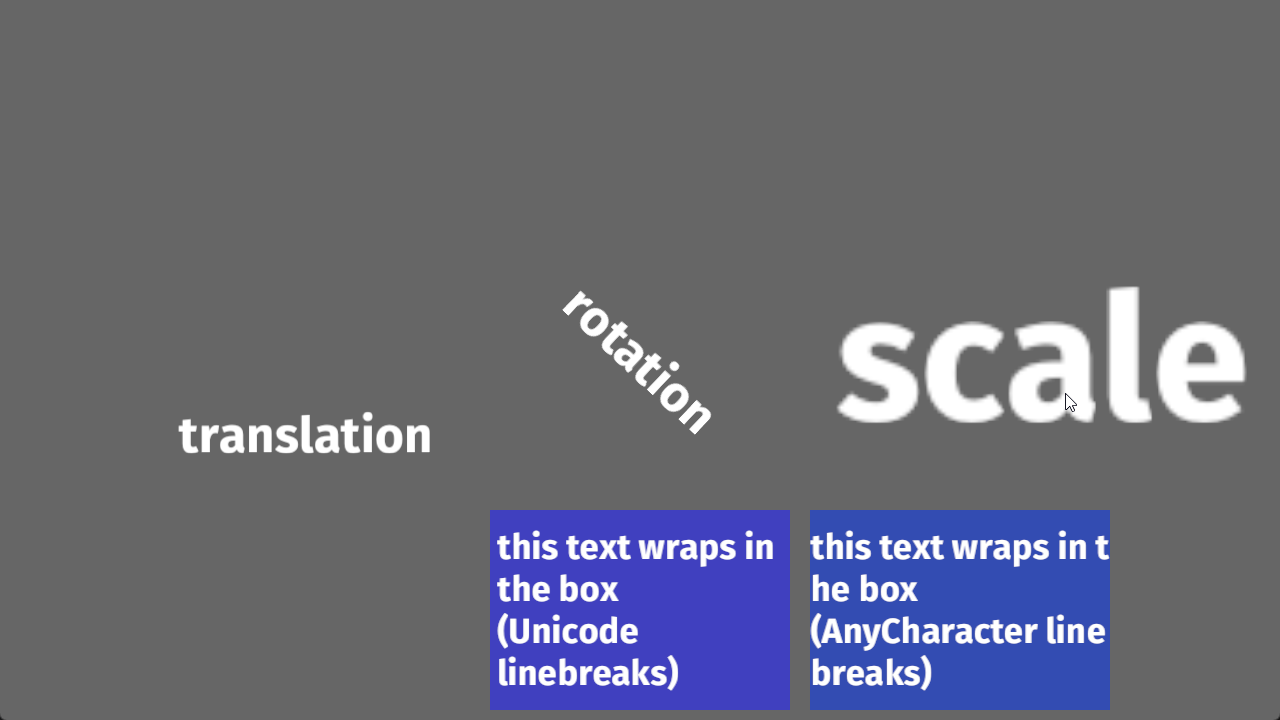 |
||
|
ickshonpe
|
9eefd7c022 |
Remove VerticalAlign from TextAlignment (#6807)
# Objective Remove the `VerticalAlign` enum. Text's alignment field should only affect the text's internal text alignment, not its position. The only way to control a `TextBundle`'s position and bounds should be through the manipulation of the constraints in the `Style` components of the nodes in the Bevy UI's layout tree. `Text2dBundle` should have a separate `Anchor` component that sets its position relative to its transform. Related issues: #676, #1490, #5502, #5513, #5834, #6717, #6724, #6741, #6748 ## Changelog * Changed `TextAlignment` into an enum with `Left`, `Center`, and `Right` variants. * Removed the `HorizontalAlign` and `VerticalAlign` types. * Added an `Anchor` component to `Text2dBundle` * Added `Component` derive to `Anchor` * Use `f32::INFINITY` instead of `f32::MAX` to represent unbounded text in Text2dBounds ## Migration Guide The `alignment` field of `Text` now only affects the text's internal alignment. ### Change `TextAlignment` to TextAlignment` which is now an enum. Replace: * `TextAlignment::TOP_LEFT`, `TextAlignment::CENTER_LEFT`, `TextAlignment::BOTTOM_LEFT` with `TextAlignment::Left` * `TextAlignment::TOP_CENTER`, `TextAlignment::CENTER_LEFT`, `TextAlignment::BOTTOM_CENTER` with `TextAlignment::Center` * `TextAlignment::TOP_RIGHT`, `TextAlignment::CENTER_RIGHT`, `TextAlignment::BOTTOM_RIGHT` with `TextAlignment::Right` ### Changes for `Text2dBundle` `Text2dBundle` has a new field 'text_anchor' that takes an `Anchor` component that controls its position relative to its transform. |
||
|
Cameron
|
7989cb2650 |
Add global time scaling (#5752)
# Objective - Make `Time` API more consistent. - Support time accel/decel/pause. ## Solution This is just the `Time` half of #3002. I was told that part isn't controversial. - Give the "delta time" and "total elapsed time" methods `f32`, `f64`, and `Duration` variants with consistent naming. - Implement accelerating / decelerating the passage of time. - Implement stopping time. --- ## Changelog - Changed `time_since_startup` to `elapsed` because `time.time_*` is just silly. - Added `relative_speed` and `set_relative_speed` methods. - Added `is_paused`, `pause`, `unpause` , and methods. (I'd prefer `resume`, but `unpause` matches `Timer` API.) - Added `raw_*` variants of the "delta time" and "total elapsed time" methods. - Added `first_update` method because there's a non-zero duration between startup and the first update. ## Migration Guide - `time.time_since_startup()` -> `time.elapsed()` - `time.seconds_since_startup()` -> `time.elapsed_seconds_f64()` - `time.seconds_since_startup_wrapped_f32()` -> `time.elapsed_seconds_wrapped()` If you aren't sure which to use, most systems should continue to use "scaled" time (e.g. `time.delta_seconds()`). The realtime "unscaled" time measurements (e.g. `time.raw_delta_seconds()`) are mostly for debugging and profiling. |
||
|
Michel van der Hulst
|
0981789ec7 |
Fixes incorrect glyph positioning for text2d (#6273)
# Objective Fixes #6272 ## Solution Revert to old way of positioning text for Text2D rendered text. Co-authored-by: Michel van der Hulst <hulstmichel@gmail.com> |
||
|
Carter Anderson
|
01aedc8431 |
Spawn now takes a Bundle (#6054)
# Objective Now that we can consolidate Bundles and Components under a single insert (thanks to #2975 and #6039), almost 100% of world spawns now look like `world.spawn().insert((Some, Tuple, Here))`. Spawning an entity without any components is an extremely uncommon pattern, so it makes sense to give spawn the "first class" ergonomic api. This consolidated api should be made consistent across all spawn apis (such as World and Commands). ## Solution All `spawn` apis (`World::spawn`, `Commands:;spawn`, `ChildBuilder::spawn`, and `WorldChildBuilder::spawn`) now accept a bundle as input: ```rust // before: commands .spawn() .insert((A, B, C)); world .spawn() .insert((A, B, C); // after commands.spawn((A, B, C)); world.spawn((A, B, C)); ``` All existing instances of `spawn_bundle` have been deprecated in favor of the new `spawn` api. A new `spawn_empty` has been added, replacing the old `spawn` api. By allowing `world.spawn(some_bundle)` to replace `world.spawn().insert(some_bundle)`, this opened the door to removing the initial entity allocation in the "empty" archetype / table done in `spawn()` (and subsequent move to the actual archetype in `.insert(some_bundle)`). This improves spawn performance by over 10%: 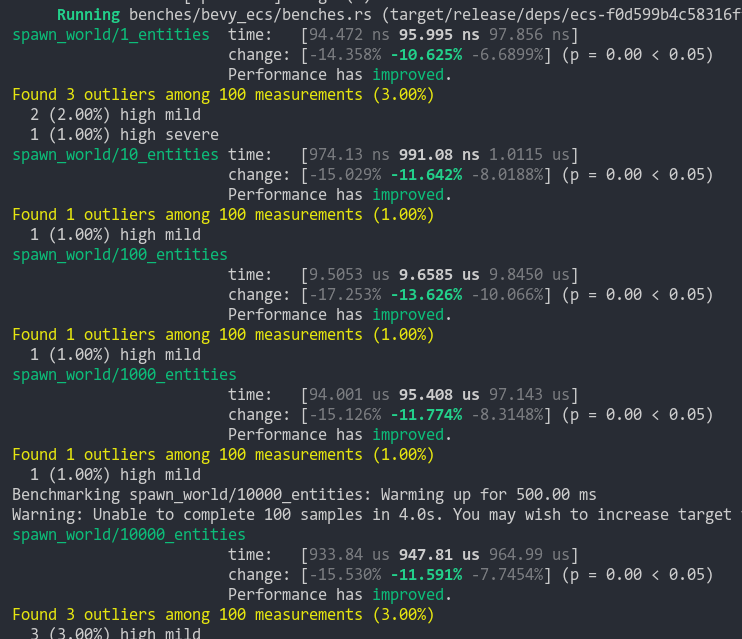 To take this measurement, I added a new `world_spawn` benchmark. Unfortunately, optimizing `Commands::spawn` is slightly less trivial, as Commands expose the Entity id of spawned entities prior to actually spawning. Doing the optimization would (naively) require assurances that the `spawn(some_bundle)` command is applied before all other commands involving the entity (which would not necessarily be true, if memory serves). Optimizing `Commands::spawn` this way does feel possible, but it will require careful thought (and maybe some additional checks), which deserves its own PR. For now, it has the same performance characteristics of the current `Commands::spawn_bundle` on main. **Note that 99% of this PR is simple renames and refactors. The only code that needs careful scrutiny is the new `World::spawn()` impl, which is relatively straightforward, but it has some new unsafe code (which re-uses battle tested BundlerSpawner code path).** --- ## Changelog - All `spawn` apis (`World::spawn`, `Commands:;spawn`, `ChildBuilder::spawn`, and `WorldChildBuilder::spawn`) now accept a bundle as input - All instances of `spawn_bundle` have been deprecated in favor of the new `spawn` api - World and Commands now have `spawn_empty()`, which is equivalent to the old `spawn()` behavior. ## Migration Guide ```rust // Old (0.8): commands .spawn() .insert_bundle((A, B, C)); // New (0.9) commands.spawn((A, B, C)); // Old (0.8): commands.spawn_bundle((A, B, C)); // New (0.9) commands.spawn((A, B, C)); // Old (0.8): let entity = commands.spawn().id(); // New (0.9) let entity = commands.spawn_empty().id(); // Old (0.8) let entity = world.spawn().id(); // New (0.9) let entity = world.spawn_empty(); ``` |
||
|
ira
|
9f906fdc8b |
Improve ergonomics and reduce boilerplate around creating text elements. (#5343)
# Objective Creating UI elements is very boilerplate-y with lots of indentation. This PR aims to reduce boilerplate around creating text elements. ## Changelog * Renamed `Text::with_section` to `from_section`. It no longer takes a `TextAlignment` as argument, as the vast majority of cases left it `Default::default()`. * Added `Text::from_sections` which creates a `Text` from a list of `TextSections`. Reduces line-count and reduces indentation by one level. * Added `Text::with_alignment`. A builder style method for setting the `TextAlignment` of a `Text`. * Added `TextSection::new`. Does not reduce line count, but reduces character count and made it easier to read. No more `.to_string()` calls! * Added `TextSection::from_style` which creates an empty `TextSection` with a style. No more empty strings! Reduces indentation. * Added `TextAlignment::CENTER` and friends. * Added methods to `TextBundle`. `from_section`, `from_sections`, `with_text_alignment` and `with_style`. ## Note for reviewers. Because of the nature of these changes I recommend setting diff view to 'split'. ~~Look for the book icon~~ cog in the top-left of the Files changed tab. Have fun reviewing ❤️ <sup> >:D </sup> ## Migration Guide `Text::with_section` was renamed to `from_section` and no longer takes a `TextAlignment` as argument. Use `with_alignment` to set the alignment instead. Co-authored-by: devil-ira <justthecooldude@gmail.com> |
||
|
ira
|
4847f7e3ad |
Update codebase to use IntoIterator where possible. (#5269)
Remove unnecessary calls to `iter()`/`iter_mut()`.
Mainly updates the use of queries in our code, docs, and examples.

```rust
// From
for _ in list.iter() {
for _ in list.iter_mut() {

// To
for _ in &list {
for _ in &mut list {
```

We already enable the pedantic lint [clippy::explicit_iter_loop](https://rust-lang.github.io/rust-clippy/stable/) inside of Bevy. However, this only warns for a few known types from the standard library.

## Note for reviewers
As you can see the additions and deletions are exactly equal.
Maybe give it a quick skim to check I didn't sneak in a crypto miner, but you don't have to torture yourself by reading every line.
I already experienced enough pain making this PR :)


Co-authored-by: devil-ira <justthecooldude@gmail.com>
|
||
|
Carter Anderson
|
f487407e07 |
Camera Driven Rendering (#4745)
This adds "high level camera driven rendering" to Bevy. The goal is to give users more control over what gets rendered (and where) without needing to deal with render logic. This will make scenarios like "render to texture", "multiple windows", "split screen", "2d on 3d", "3d on 2d", "pass layering", and more significantly easier. Here is an [example of a 2d render sandwiched between two 3d renders (each from a different perspective)](https://gist.github.com/cart/4fe56874b2e53bc5594a182fc76f4915): 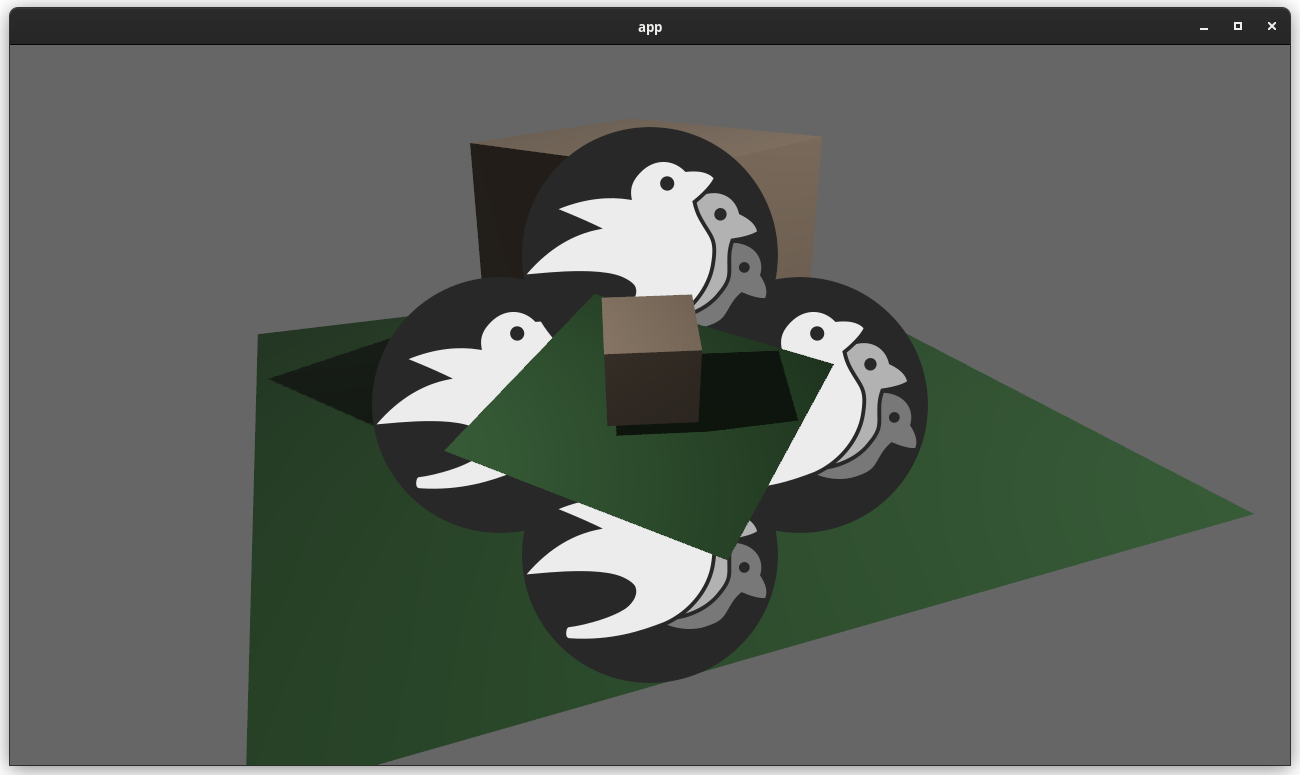 Users can now spawn a camera, point it at a RenderTarget (a texture or a window), and it will "just work". Rendering to a second window is as simple as spawning a second camera and assigning it to a specific window id: ```rust // main camera (main window) commands.spawn_bundle(Camera2dBundle::default()); // second camera (other window) commands.spawn_bundle(Camera2dBundle { camera: Camera { target: RenderTarget::Window(window_id), ..default() }, ..default() }); ``` Rendering to a texture is as simple as pointing the camera at a texture: ```rust commands.spawn_bundle(Camera2dBundle { camera: Camera { target: RenderTarget::Texture(image_handle), ..default() }, ..default() }); ``` Cameras now have a "render priority", which controls the order they are drawn in. If you want to use a camera's output texture as a texture in the main pass, just set the priority to a number lower than the main pass camera (which defaults to `0`). ```rust // main pass camera with a default priority of 0 commands.spawn_bundle(Camera2dBundle::default()); commands.spawn_bundle(Camera2dBundle { camera: Camera { target: RenderTarget::Texture(image_handle.clone()), priority: -1, ..default() }, ..default() }); commands.spawn_bundle(SpriteBundle { texture: image_handle, ..default() }) ``` Priority can also be used to layer to cameras on top of each other for the same RenderTarget. This is what "2d on top of 3d" looks like in the new system: ```rust commands.spawn_bundle(Camera3dBundle::default()); commands.spawn_bundle(Camera2dBundle { camera: Camera { // this will render 2d entities "on top" of the default 3d camera's render priority: 1, ..default() }, ..default() }); ``` There is no longer the concept of a global "active camera". Resources like `ActiveCamera<Camera2d>` and `ActiveCamera<Camera3d>` have been replaced with the camera-specific `Camera::is_active` field. This does put the onus on users to manage which cameras should be active. Cameras are now assigned a single render graph as an "entry point", which is configured on each camera entity using the new `CameraRenderGraph` component. The old `PerspectiveCameraBundle` and `OrthographicCameraBundle` (generic on camera marker components like Camera2d and Camera3d) have been replaced by `Camera3dBundle` and `Camera2dBundle`, which set 3d and 2d default values for the `CameraRenderGraph` and projections. ```rust // old 3d perspective camera commands.spawn_bundle(PerspectiveCameraBundle::default()) // new 3d perspective camera commands.spawn_bundle(Camera3dBundle::default()) ``` ```rust // old 2d orthographic camera commands.spawn_bundle(OrthographicCameraBundle::new_2d()) // new 2d orthographic camera commands.spawn_bundle(Camera2dBundle::default()) ``` ```rust // old 3d orthographic camera commands.spawn_bundle(OrthographicCameraBundle::new_3d()) // new 3d orthographic camera commands.spawn_bundle(Camera3dBundle { projection: OrthographicProjection { scale: 3.0, scaling_mode: ScalingMode::FixedVertical, ..default() }.into(), ..default() }) ``` Note that `Camera3dBundle` now uses a new `Projection` enum instead of hard coding the projection into the type. There are a number of motivators for this change: the render graph is now a part of the bundle, the way "generic bundles" work in the rust type system prevents nice `..default()` syntax, and changing projections at runtime is much easier with an enum (ex for editor scenarios). I'm open to discussing this choice, but I'm relatively certain we will all come to the same conclusion here. Camera2dBundle and Camera3dBundle are much clearer than being generic on marker components / using non-default constructors. If you want to run a custom render graph on a camera, just set the `CameraRenderGraph` component: ```rust commands.spawn_bundle(Camera3dBundle { camera_render_graph: CameraRenderGraph::new(some_render_graph_name), ..default() }) ``` Just note that if the graph requires data from specific components to work (such as `Camera3d` config, which is provided in the `Camera3dBundle`), make sure the relevant components have been added. Speaking of using components to configure graphs / passes, there are a number of new configuration options: ```rust commands.spawn_bundle(Camera3dBundle { camera_3d: Camera3d { // overrides the default global clear color clear_color: ClearColorConfig::Custom(Color::RED), ..default() }, ..default() }) commands.spawn_bundle(Camera3dBundle { camera_3d: Camera3d { // disables clearing clear_color: ClearColorConfig::None, ..default() }, ..default() }) ``` Expect to see more of the "graph configuration Components on Cameras" pattern in the future. By popular demand, UI no longer requires a dedicated camera. `UiCameraBundle` has been removed. `Camera2dBundle` and `Camera3dBundle` now both default to rendering UI as part of their own render graphs. To disable UI rendering for a camera, disable it using the CameraUi component: ```rust commands .spawn_bundle(Camera3dBundle::default()) .insert(CameraUi { is_enabled: false, ..default() }) ``` ## Other Changes * The separate clear pass has been removed. We should revisit this for things like sky rendering, but I think this PR should "keep it simple" until we're ready to properly support that (for code complexity and performance reasons). We can come up with the right design for a modular clear pass in a followup pr. * I reorganized bevy_core_pipeline into Core2dPlugin and Core3dPlugin (and core_2d / core_3d modules). Everything is pretty much the same as before, just logically separate. I've moved relevant types (like Camera2d, Camera3d, Camera3dBundle, Camera2dBundle) into their relevant modules, which is what motivated this reorganization. * I adapted the `scene_viewer` example (which relied on the ActiveCameras behavior) to the new system. I also refactored bits and pieces to be a bit simpler. * All of the examples have been ported to the new camera approach. `render_to_texture` and `multiple_windows` are now _much_ simpler. I removed `two_passes` because it is less relevant with the new approach. If someone wants to add a new "layered custom pass with CameraRenderGraph" example, that might fill a similar niche. But I don't feel much pressure to add that in this pr. * Cameras now have `target_logical_size` and `target_physical_size` fields, which makes finding the size of a camera's render target _much_ simpler. As a result, the `Assets<Image>` and `Windows` parameters were removed from `Camera::world_to_screen`, making that operation much more ergonomic. * Render order ambiguities between cameras with the same target and the same priority now produce a warning. This accomplishes two goals: 1. Now that there is no "global" active camera, by default spawning two cameras will result in two renders (one covering the other). This would be a silent performance killer that would be hard to detect after the fact. By detecting ambiguities, we can provide a helpful warning when this occurs. 2. Render order ambiguities could result in unexpected / unpredictable render results. Resolving them makes sense. ## Follow Up Work * Per-Camera viewports, which will make it possible to render to a smaller area inside of a RenderTarget (great for something like splitscreen) * Camera-specific MSAA config (should use the same "overriding" pattern used for ClearColor) * Graph Based Camera Ordering: priorities are simple, but they make complicated ordering constraints harder to express. We should consider adopting a "graph based" camera ordering model with "before" and "after" relationships to other cameras (or build it "on top" of the priority system). * Consider allowing graphs to run subgraphs from any nest level (aka a global namespace for graphs). Right now the 2d and 3d graphs each need their own UI subgraph, which feels "fine" in the short term. But being able to share subgraphs between other subgraphs seems valuable. * Consider splitting `bevy_core_pipeline` into `bevy_core_2d` and `bevy_core_3d` packages. Theres a shared "clear color" dependency here, which would need a new home. |
||
|
Mark Schmale
|
1ba7429371 |
Doc/module style doc blocks for examples (#4438)
# Objective Provide a starting point for #3951, or a partial solution. Providing a few comment blocks to discuss, and hopefully find better one in the process. ## Solution Since I am pretty new to pretty much anything in this context, I figured I'd just start with a draft for some file level doc blocks. For some of them I found more relevant details (or at least things I considered interessting), for some others there is less. ## Changelog - Moved some existing comments from main() functions in the 2d examples to the file header level - Wrote some more comment blocks for most other 2d examples TODO: - [x] 2d/sprite_sheet, wasnt able to come up with something good yet - [x] all other example groups... Also: Please let me know if the commit style is okay, or to verbose. I could certainly squash these things, or add more details if needed. I also hope its okay to raise this PR this early, with just a few files changed. Took me long enough and I dont wanted to let it go to waste because I lost motivation to do the whole thing. Additionally I am somewhat uncertain over the style and contents of the commets. So let me know what you thing please. |


