# Objective

Remove the `new_with_` prefixes from the `TextLayout` constuctor
functions. Generally, the "new" part is redundant and "with" is used by
fluent APIs.

## Solution

Just delete the prefixes, shorten the names (all on `TextLayout`).
* `new_with_justify` -> `justify`
* `new_with_linebreak` -> `linebreak`
* `new_with_no_wrap` -> `no_wrap`
# Objective
As raised in
[#23174](https://github.com/bevyengine/bevy/pull/23174#discussion_r2868030355_),
we currently duplicate working when looking up our system parameters:
once during validation, and then again when actually fetching the data.
This is (maybe) slow, and would worsen the performance regression
incurred by resources-as-components (#19731).
This strategy also imposes some non-trivial complexity and
maintainability costs. Because "validate" is a distinct step from "use",
it's possible to skip validation! As far as I could tell, this is the
case in a number of places before this PR: particularly in the
unconventional "please just run my system" path. While in most cases
this will simply result in a crash in a different place, it causes these
paths to not handle
Fixes#23179. Fixes#15505.
## Solution
Fundamentally, what we're doing is rolling the
`SystemParam::validate_param` behavior into `SystemParam::get_param`, by
making the latter return a `Result`.
However, there is a tremendous amount of splash damage required to get
that to actually compile and expose the correct semantics. The most
important of these are:
- `SystemState::get` and friends now returns a `Result`
- this leads to a fair bit of assorted unwrap spam in our tests and
weird internal usages
- these tests can probably be refactored to not use `SystemState`
directly in the future now that we have better tools like
`run_system_once`, but eh, not this PR's job
- this is semantically correct, as these params could fail validation
- `System::validate_param_unsafe` has been removed, and validation now
occurs inside of `System::run_unsafe`
- very much a net positive for both abstract robustness and current
correctness
- this impacts the strategy that various executors use: see the next
section
There are a *lot* of moving parts here: I'm sorry that I couldn't get
this into a smaller, more incremental refactor. When reviewing this PR,
you should begin with the migration guide to help get you oriented on
the details: `validation_merging.md`.
From there, the most important files to review are:
1. `system_param.rs`: trait changes and implementers
2. `function_system.rs`: primary implementer of `System`
3. `multithreaded.rs`: the parallel executor
**NOTE TO REVIEWERS:** Please make comments to generate threads; this PR
review might get fairly hairy.
### Performance discussion
For the parallel `MultithreadedExecutor`, validation was previously done
as a cheap pre-validation step,
while checking run conditions.
Now, tasks will be spawned for systems which would fail or are skipped
during validation.
In most cases, avoiding the extra overhead of looking up the required
data twice should dominate.
However, this change may negatively affect systems which are frequently
skipped (e.g. due to `Single`).
### Paths not taken
In this PR, I've decided not to:
- Add another variant
[RunSystemError](https://docs.rs/bevy/latest/bevy/ecs/system/enum.RunSystemError.html),
distinguishing "validation failed" from "system ran but returned an
error".
- While reusing
[RunSystemError::Failed](https://docs.rs/bevy/latest/bevy/ecs/system/enum.RunSystemError.html#variant.Failed)
for both cases is messy, this PR is already a bit of a nightmare to
review.
- Return a result from `ParamSet::get_mut`.
- Instead, we just `unwrap`.
- Bubbling up the `Result` is technically more correct, but these were
already panicking before if e.g. a resource is missing, and `ParamSet`
is already an ergonomic abomination.
## Testing
I've added a number of new tests to exercise the system param validation
paths, ensuring that validation is done when systems are run.
However, I would appreciate some help benchmarking the net impact on
realistic-ish scenes. `breakout`, `bevy_city` and `many_animated_foxes`
are probably a decent scattering, but I'd be very open to other
suggestions.
Having done this refactor, I think that it's a net improvement for
robustness and clarity even without the perf benefits however, and that
we should proceed unless this is a clear regression.
---------
Co-authored-by: Chris Russell <8494645+chescock@users.noreply.github.com>
Co-authored-by: Kevin Chen <chen.kevin.f@gmail.com>
# Objective

- `glam`, `hexasphere` & `rand` have released their latest versions,
update Bevy to support them.

## Solution

- The above have been updated to their compatible versions. `rand_distr`
updated as well to match `rand` v0.10 support.
- `rand_chacha` is soft deprecated and no longer used by `rand`, so its
usage has been changed to `chacha20` to match `rand` dep tree.
- `uuid` is in the process of updating to `getrandom` v0.4, which `rand`
v0.10 supports. This PR remains in draft until a new `uuid` release hits
crates.io.
- `RngCore` is now `Rng`, and `Rng` is now `RngExt`, so this required
updating across many files.
- `choose_multiple` method is deprecated, changed to `sample`.

## Testing

- Chase all compiler errors, since this should not regress any already
existing behaviour.
- This must pass CI without regressions.

## Additional Notes

`getrandom` v0.4 doesn't add anything new for Web WASM support, so the
same `wasm_js` feature is used.
# Objective
In #21598 and the related Discord discussion, it was pointed out that
the `async_compute` example promotes an inefficient and potentially
error-prone pattern: `future::block_on(poll_once)`.
It is now recommended to use `bevy::tasks::futures::check_ready`
instead, which is much cheaper and avoids blocking the main thread while
waiting on the future. Another valid approach is to pass a channel into
the async tasks and detach them, letting the channel handle task
readiness.
This PR implements both suggestions.
## Solution
* **Updated `async_compute` example**
Replaced the use of `future::block_on(poll_once)` with the recommended
`check_ready`.
The change is minimal and limited to the directly affected lines.
* **Added new example: `async_channel_pattern`**
Demonstrates how to spawn async tasks using a channel-based
communication pattern.
* Each task is executed on a separate thread via `AsyncComputeTaskPool`.
* Results (cube positions) are sent back through a `CubeChannel` once
completed.
* Tasks are detached to run fully asynchronously, ensuring the main
thread remains unblocked.
* A rotating light in the scene visually indicates that the frame loop
remains responsive.
I am relatively new to both Bevy and async Rust, and I genuinely
appreciate any feedback or suggestions to improve these examples —
especially regarding idiomatic async patterns and best practices for
Bevy task management.
Fixes#21598
---------
Co-authored-by: syszery <syszery@users.noreply.github.com>
Co-authored-by: François Mockers <francois.mockers@vleue.com>
This renames the concept of `BufferedEvent` to `Message`, and updates
our APIs, comments, and documentation to refer to these types as
"messages" instead of "events". It also removes/updates anything that
considers messages to be "observable", "listenable", or "triggerable".

This is a followup to https://github.com/bevyengine/bevy/pull/20731,
which omitted the `BufferedEvent -> Message` rename for brevity.

See that post for rationale.
# Objective
- Fixes#19055
## Solution
- Replace `async-std` with `futures-timer`.
## Testing
CI
---------
Co-authored-by: James Liu <contact@jamessliu.com>
# Objective

New `rand` version, which means updating `glam` and `encase` to support
the newer ecosystem update. Does mean that this changes how WASM builds
need to be done in order to configure `getrandom` correctly, but this
can be remedied with updated docs.

## Solution

Updating all needed dependencies to their compatible versions. ~~This PR
is currently blocked by `encase`, which is waiting on [this
PR](https://github.com/teoxoy/encase/pull/88) to be merged and then a
new version published.~~ ~~This PR is no longer blocked~~,
~~`hexasphere` is blocking this PR now due to not yet having a new
release with the latest `glam` version support~~, The PR is all good to
go now, everything in order across glam/rand deps.

## Testing

- Must pass CI for all checks, tests, not introduce breaking changes.

---

## Migration Guide

With newer versions of `glam` & `encase`, the updated versions don't
seem to have introduced breakages, though as always, best to consult
their docs [1](https://docs.rs/glam/latest/glam/)
[2](https://docs.rs/encase/0.11.0/encase/) for any changes.

`rand` changes are more extensive, with changes such as `thread_rng()`
-> `rng()`, `from_entropy()` -> `from_os_rng()`, and so forth. `RngCore`
is now split into infallible `RngCore` and fallible `TryRngCore`, and
the `distributions` module has been renamed to `distr`. Most of this
affects only internals, and doesn't directly affect Bevy's APIs. For the
full set of changes, see `rand` [migration
notes](https://rust-random.github.io/book/update-0.9.html).

`getrandom` is also updated, and will require additional configuration
when building Bevy for WASM/Web (if also using `rand`). The full details
of how to do this is in the `getrandom` docs
[1](https://github.com/rust-random/getrandom?tab=readme-ov-file#opt-in-backends)
[2](https://github.com/rust-random/getrandom?tab=readme-ov-file#webassembly-support).

---------

Co-authored-by: François Mockers <francois.mockers@vleue.com>
# Objective

- It seems counterintuitive that the task removes itself
- More than once I have tried copying the code from this example and
then remove the content of the task to replace it with what I need and
then I get errors about a task being polled after it's already completed
because I never removed it.

## Solution

- Remove the task in the handle_tasks system after it's done being
"handled".

## Testing

- Ran the example and it still works as expected
# Objective

> I think we should axe the shared `Event` trait entirely
It doesn't serve any functional purpose, and I don't think it's useful
pedagogically
@alice-i-cecile on discord

## Solution

- Remove `Event` as a supertrait of `BufferedEvent`
- Remove any `Event` derives that were made unnecessary
- Update release notes

---------

Co-authored-by: SpecificProtagonist <vincentjunge@posteo.net>
# Objective
Closes#19564.
The current `Event` trait looks like this:
```rust
pub trait Event: Send + Sync + 'static {
type Traversal: Traversal<Self>;
const AUTO_PROPAGATE: bool = false;
fn register_component_id(world: &mut World) -> ComponentId { ... }
fn component_id(world: &World) -> Option<ComponentId> { ... }
}
```
The `Event` trait is used by both buffered events
(`EventReader`/`EventWriter`) and observer events. If they are observer
events, they can optionally be targeted at specific `Entity`s or
`ComponentId`s, and can even be propagated to other entities.
However, there has long been a desire to split the trait semantically
for a variety of reasons, see #14843, #14272, and #16031 for discussion.
Some reasons include:
- It's very uncommon to use a single event type as both a buffered event
and targeted observer event. They are used differently and tend to have
distinct semantics.
- A common footgun is using buffered events with observers or event
readers with observer events, as there is no type-level error that
prevents this kind of misuse.
- #19440 made `Trigger::target` return an `Option<Entity>`. This
*seriously* hurts ergonomics for the general case of entity observers,
as you need to `.unwrap()` each time. If we could statically determine
whether the event is expected to have an entity target, this would be
unnecessary.
There's really two main ways that we can categorize events: push vs.
pull (i.e. "observer event" vs. "buffered event") and global vs.
targeted:
| | Push | Pull |
| ------------ | --------------- | --------------------------- |
| **Global** | Global observer | `EventReader`/`EventWriter` |
| **Targeted** | Entity observer | - |
There are many ways to approach this, each with their tradeoffs.
Ultimately, we kind of want to split events both ways:
- A type-level distinction between observer events and buffered events,
to prevent people from using the wrong kind of event in APIs
- A statically designated entity target for observer events to avoid
accidentally using untargeted events for targeted APIs
This PR achieves these goals by splitting event traits into `Event`,
`EntityEvent`, and `BufferedEvent`, with `Event` being the shared trait
implemented by all events.
## `Event`, `EntityEvent`, and `BufferedEvent`
`Event` is now a very simple trait shared by all events.
```rust
pub trait Event: Send + Sync + 'static {
// Required for observer APIs
fn register_component_id(world: &mut World) -> ComponentId { ... }
fn component_id(world: &World) -> Option<ComponentId> { ... }
}
```
You can call `trigger` for *any* event, and use a global observer for
listening to the event.
```rust
#[derive(Event)]
struct Speak {
message: String,
}
// ...
app.add_observer(|trigger: On<Speak>| {
println!("{}", trigger.message);
});
// ...
commands.trigger(Speak {
message: "Y'all like these reworked events?".to_string(),
});
```
To allow an event to be targeted at entities and even propagated
further, you can additionally implement the `EntityEvent` trait:
```rust
pub trait EntityEvent: Event {
type Traversal: Traversal<Self>;
const AUTO_PROPAGATE: bool = false;
}
```
This lets you call `trigger_targets`, and to use targeted observer APIs
like `EntityCommands::observe`:
```rust
#[derive(Event, EntityEvent)]
#[entity_event(traversal = &'static ChildOf, auto_propagate)]
struct Damage {
amount: f32,
}
// ...
let enemy = commands.spawn((Enemy, Health(100.0))).id();
// Spawn some armor as a child of the enemy entity.
// When the armor takes damage, it will bubble the event up to the enemy.
let armor_piece = commands
.spawn((ArmorPiece, Health(25.0), ChildOf(enemy)))
.observe(|trigger: On<Damage>, mut query: Query<&mut Health>| {
// Note: `On::target` only exists because this is an `EntityEvent`.
let mut health = query.get(trigger.target()).unwrap();
health.0 -= trigger.amount();
});
commands.trigger_targets(Damage { amount: 10.0 }, armor_piece);
```
> [!NOTE]
> You *can* still also trigger an `EntityEvent` without targets using
`trigger`. We probably *could* make this an either-or thing, but I'm not
sure that's actually desirable.
To allow an event to be used with the buffered API, you can implement
`BufferedEvent`:
```rust
pub trait BufferedEvent: Event {}
```
The event can then be used with `EventReader`/`EventWriter`:
```rust
#[derive(Event, BufferedEvent)]
struct Message(String);
fn write_hello(mut writer: EventWriter<Message>) {
writer.write(Message("I hope these examples are alright".to_string()));
}
fn read_messages(mut reader: EventReader<Message>) {
// Process all buffered events of type `Message`.
for Message(message) in reader.read() {
println!("{message}");
}
}
```
In summary:
- Need a basic event you can trigger and observe? Derive `Event`!
- Need the event to be targeted at an entity? Derive `EntityEvent`!
- Need the event to be buffered and support the
`EventReader`/`EventWriter` API? Derive `BufferedEvent`!
## Alternatives
I'll now cover some of the alternative approaches I have considered and
briefly explored. I made this section collapsible since it ended up
being quite long :P
<details>
<summary>Expand this to see alternatives</summary>
### 1. Unified `Event` Trait
One option is not to have *three* separate traits (`Event`,
`EntityEvent`, `BufferedEvent`), and to instead just use associated
constants on `Event` to determine whether an event supports targeting
and buffering or not:
```rust
pub trait Event: Send + Sync + 'static {
type Traversal: Traversal<Self>;
const AUTO_PROPAGATE: bool = false;
const TARGETED: bool = false;
const BUFFERED: bool = false;
fn register_component_id(world: &mut World) -> ComponentId { ... }
fn component_id(world: &World) -> Option<ComponentId> { ... }
}
```
Methods can then use bounds like `where E: Event<TARGETED = true>` or
`where E: Event<BUFFERED = true>` to limit APIs to specific kinds of
events.
This would keep everything under one `Event` trait, but I don't think
it's necessarily a good idea. It makes APIs harder to read, and docs
can't easily refer to specific types of events. You can also create
weird invariants: what if you specify `TARGETED = false`, but have
`Traversal` and/or `AUTO_PROPAGATE` enabled?
### 2. `Event` and `Trigger`
Another option is to only split the traits between buffered events and
observer events, since that is the main thing people have been asking
for, and they have the largest API difference.
If we did this, I think we would need to make the terms *clearly*
separate. We can't really use `Event` and `BufferedEvent` as the names,
since it would be strange that `BufferedEvent` doesn't implement
`Event`. Something like `ObserverEvent` and `BufferedEvent` could work,
but it'd be more verbose.
For this approach, I would instead keep `Event` for the current
`EventReader`/`EventWriter` API, and call the observer event a
`Trigger`, since the "trigger" terminology is already used in the
observer context within Bevy (both as a noun and a verb). This is also
what a long [bikeshed on
Discord](https://discord.com/channels/691052431525675048/749335865876021248/1298057661878898791)
seemed to land on at the end of last year.
```rust
// For `EventReader`/`EventWriter`
pub trait Event: Send + Sync + 'static {}
// For observers
pub trait Trigger: Send + Sync + 'static {
type Traversal: Traversal<Self>;
const AUTO_PROPAGATE: bool = false;
const TARGETED: bool = false;
fn register_component_id(world: &mut World) -> ComponentId { ... }
fn component_id(world: &World) -> Option<ComponentId> { ... }
}
```
The problem is that "event" is just a really good term for something
that "happens". Observers are rapidly becoming the more prominent API,
so it'd be weird to give them the `Trigger` name and leave the good
`Event` name for the less common API.
So, even though a split like this seems neat on the surface, I think it
ultimately wouldn't really work. We want to keep the `Event` name for
observer events, and there is no good alternative for the buffered
variant. (`Message` was suggested, but saying stuff like "sends a
collision message" is weird.)
### 3. `GlobalEvent` + `TargetedEvent`
What if instead of focusing on the buffered vs. observed split, we
*only* make a distinction between global and targeted events?
```rust
// A shared event trait to allow global observers to work
pub trait Event: Send + Sync + 'static {
fn register_component_id(world: &mut World) -> ComponentId { ... }
fn component_id(world: &World) -> Option<ComponentId> { ... }
}
// For buffered events and non-targeted observer events
pub trait GlobalEvent: Event {}
// For targeted observer events
pub trait TargetedEvent: Event {
type Traversal: Traversal<Self>;
const AUTO_PROPAGATE: bool = false;
}
```
This is actually the first approach I implemented, and it has the neat
characteristic that you can only use non-targeted APIs like `trigger`
with a `GlobalEvent` and targeted APIs like `trigger_targets` with a
`TargetedEvent`. You have full control over whether the entity should or
should not have a target, as they are fully distinct at the type-level.
However, there's a few problems:
- There is no type-level indication of whether a `GlobalEvent` supports
buffered events or just non-targeted observer events
- An `Event` on its own does literally nothing, it's just a shared trait
required to make global observers accept both non-targeted and targeted
events
- If an event is both a `GlobalEvent` and `TargetedEvent`, global
observers again have ambiguity on whether an event has a target or not,
undermining some of the benefits
- The names are not ideal
### 4. `Event` and `EntityEvent`
We can fix some of the problems of Alternative 3 by accepting that
targeted events can also be used in non-targeted contexts, and simply
having the `Event` and `EntityEvent` traits:
```rust
// For buffered events and non-targeted observer events
pub trait Event: Send + Sync + 'static {
fn register_component_id(world: &mut World) -> ComponentId { ... }
fn component_id(world: &World) -> Option<ComponentId> { ... }
}
// For targeted observer events
pub trait EntityEvent: Event {
type Traversal: Traversal<Self>;
const AUTO_PROPAGATE: bool = false;
}
```
This is essentially identical to this PR, just without a dedicated
`BufferedEvent`. The remaining major "problem" is that there is still
zero type-level indication of whether an `Event` event *actually*
supports the buffered API. This leads us to the solution proposed in
this PR, using `Event`, `EntityEvent`, and `BufferedEvent`.
</details>
## Conclusion
The `Event` + `EntityEvent` + `BufferedEvent` split proposed in this PR
aims to solve all the common problems with Bevy's current event model
while keeping the "weirdness" factor minimal. It splits in terms of both
the push vs. pull *and* global vs. targeted aspects, while maintaining a
shared concept for an "event".
### Why I Like This
- The term "event" remains as a single concept for all the different
kinds of events in Bevy.
- Despite all event types being "events", they use fundamentally
different APIs. Instead of assuming that you can use an event type with
any pattern (when only one is typically supported), you explicitly opt
in to each one with dedicated traits.
- Using separate traits for each type of event helps with documentation
and clearer function signatures.
- I can safely make assumptions on expected usage.
- If I see that an event is an `EntityEvent`, I can assume that I can
use `observe` on it and get targeted events.
- If I see that an event is a `BufferedEvent`, I can assume that I can
use `EventReader` to read events.
- If I see both `EntityEvent` and `BufferedEvent`, I can assume that
both APIs are supported.
In summary: This allows for a unified concept for events, while limiting
the different ways to use them with opt-in traits. No more guess-work
involved when using APIs.
### Problems?
- Because `BufferedEvent` implements `Event` (for more consistent
semantics etc.), you can still use all buffered events for non-targeted
observers. I think this is fine/good. The important part is that if you
see that an event implements `BufferedEvent`, you know that the
`EventReader`/`EventWriter` API should be supported. Whether it *also*
supports other APIs is secondary.
- I currently only support `trigger_targets` for an `EntityEvent`.
However, you can technically target components too, without targeting
any entities. I consider that such a niche and advanced use case that
it's not a huge problem to only support it for `EntityEvent`s, but we
could also split `trigger_targets` into `trigger_entities` and
`trigger_components` if we wanted to (or implement components as
entities :P).
- You can still trigger an `EntityEvent` *without* targets. I consider
this correct, since `Event` implements the non-targeted behavior, and
it'd be weird if implementing another trait *removed* behavior. However,
it does mean that global observers for entity events can technically
return `Entity::PLACEHOLDER` again (since I got rid of the
`Option<Entity>` added in #19440 for ergonomics). I think that's enough
of an edge case that it's not a huge problem, but it is worth keeping in
mind.
- ~~Deriving both `EntityEvent` and `BufferedEvent` for the same type
currently duplicates the `Event` implementation, so you instead need to
manually implement one of them.~~ Changed to always requiring `Event` to
be derived.
## Related Work
There are plans to implement multi-event support for observers,
especially for UI contexts. [Cart's
example](https://github.com/bevyengine/bevy/issues/14649#issuecomment-2960402508)
API looked like this:
```rust
// Truncated for brevity
trigger: Trigger<(
OnAdd<Pressed>,
OnRemove<Pressed>,
OnAdd<InteractionDisabled>,
OnRemove<InteractionDisabled>,
OnInsert<Hovered>,
)>,
```
I believe this shouldn't be in conflict with this PR. If anything, this
PR might *help* achieve the multi-event pattern for entity observers
with fewer footguns: by statically enforcing that all of these events
are `EntityEvent`s in the context of `EntityCommands::observe`, we can
avoid misuse or weird cases where *some* events inside the trigger are
targeted while others are not.
# Objective
Rename `JustifyText`:
* The name `JustifyText` is just ugly.
* It's inconsistent since no other `bevy_text` types have a `Text-`
suffix, only prefix.
* It's inconsistent with the other text layout enum `Linebreak` which
doesn't have a prefix or suffix.
Fixes#19521.
## Solution
Rename `JustifyText` to `Justify`.
Without other context, it's natural to assume the name `Justify` refers
to text justification.
---------
Co-authored-by: Alice Cecile <alice.i.cecile@gmail.com>
Fixes#17856.
## Migration Guide
- `EventWriter::send` has been renamed to `EventWriter::write`.
- `EventWriter::send_batch` has been renamed to
`EventWriter::write_batch`.
- `EventWriter::send_default` has been renamed to
`EventWriter::write_default`.
---------
Co-authored-by: François Mockers <mockersf@gmail.com>
Fixes#15834
## Migration Guide
The APIs of `Time`, `Timer` and `Stopwatch` have been cleaned up for
consistency with each other and the standard library's `Duration` type.
The following methods have been renamed:
- `Stowatch::paused` -> `Stopwatch::is_paused`
- `Time::elapsed_seconds` -> `Time::elasped_secs` (including `_f64` and
`_wrapped` variants)
# Objective

Currently text is recomputed unnecessarily on any changes to its color,
which is extremely expensive.

## Solution
Split up `TextStyle` into two separate components `TextFont` and
`TextColor`.

## Testing

I added this system to `many_buttons`:
```rust
fn set_text_colors_changed(mut colors: Query<&mut TextColor>) {
    for mut text_color in colors.iter_mut() {
        text_color.set_changed();
    }
}
```

reports ~4fps on main, ~50fps with this PR.

## Migration Guide
`TextStyle` has been renamed to `TextFont` and its `color` field has
been moved to a separate component named `TextColor` which newtypes
`Color`.
**Ready for review. Examples migration progress: 100%.**

# Objective

- Implement https://github.com/bevyengine/bevy/discussions/15014

## Solution

This implements [cart's
proposal](https://github.com/bevyengine/bevy/discussions/15014#discussioncomment-10574459)
faithfully except for one change. I separated `TextSpan` from
`TextSpan2d` because `TextSpan` needs to require the `GhostNode`
component, which is a `bevy_ui` component only usable by UI.

Extra changes:
- Added `EntityCommands::commands_mut` that returns a mutable reference.
This is a blocker for extension methods that return something other than
`self`. Note that `sickle_ui`'s `UiBuilder::commands` returns a mutable
reference for this reason.

## Testing

- [x] Text examples all work.

---

## Showcase

TODO: showcase-worthy

## Migration Guide

TODO: very breaking

### Accessing text spans by index

Text sections are now text sections on different entities in a
hierarchy, Use the new `TextReader` and `TextWriter` system parameters
to access spans by index.

Before:
```rust
fn refresh_text(mut query: Query<&mut Text, With<TimeText>>, time: Res<Time>) {
    let text = query.single_mut();
    text.sections[1].value = format_time(time.elapsed());
}
```

After:
```rust
fn refresh_text(
    query: Query<Entity, With<TimeText>>,
    mut writer: UiTextWriter,
    time: Res<Time>
) {
    let entity = query.single();
    *writer.text(entity, 1) = format_time(time.elapsed());
}
```

### Iterating text spans

Text spans are now entities in a hierarchy, so the new `UiTextReader`
and `UiTextWriter` system parameters provide ways to iterate that
hierarchy. The `UiTextReader::iter` method will give you a normal
iterator over spans, and `UiTextWriter::for_each` lets you visit each of
the spans.

---------

Co-authored-by: ickshonpe <david.curthoys@googlemail.com>
Co-authored-by: Carter Anderson <mcanders1@gmail.com>
# Objective

Yet another PR for migrating stuff to required components. This time,
cameras!

## Solution

As per the [selected
proposal](https://hackmd.io/tsYID4CGRiWxzsgawzxG_g#Combined-Proposal-1-Selected),
deprecate `Camera2dBundle` and `Camera3dBundle` in favor of `Camera2d`
and `Camera3d`.

Adding a `Camera` without `Camera2d` or `Camera3d` now logs a warning,
as suggested by Cart [on
Discord](https://discord.com/channels/691052431525675048/1264881140007702558/1291506402832945273).
I would personally like cameras to work a bit differently and be split
into a few more components, to avoid some footguns and confusing
semantics, but that is more controversial, and shouldn't block this core
migration.

## Testing

I ran a few 2D and 3D examples, and tried cameras with and without
render graphs.

---

## Migration Guide

`Camera2dBundle` and `Camera3dBundle` have been deprecated in favor of
`Camera2d` and `Camera3d`. Inserting them will now also insert the other
components required by them automatically.
# Objective
A big step in the migration to required components: meshes and
materials!
## Solution
As per the [selected
proposal](https://hackmd.io/@bevy/required_components/%2Fj9-PnF-2QKK0on1KQ29UWQ):
- Deprecate `MaterialMesh2dBundle`, `MaterialMeshBundle`, and
`PbrBundle`.
- Add `Mesh2d` and `Mesh3d` components, which wrap a `Handle<Mesh>`.
- Add `MeshMaterial2d<M: Material2d>` and `MeshMaterial3d<M: Material>`,
which wrap a `Handle<M>`.
- Meshes *without* a mesh material should be rendered with a default
material. The existence of a material is determined by
`HasMaterial2d`/`HasMaterial3d`, which is required by
`MeshMaterial2d`/`MeshMaterial3d`. This gets around problems with the
generics.
Previously:
```rust
commands.spawn(MaterialMesh2dBundle {
mesh: meshes.add(Circle::new(100.0)).into(),
material: materials.add(Color::srgb(7.5, 0.0, 7.5)),
transform: Transform::from_translation(Vec3::new(-200., 0., 0.)),
..default()
});
```
Now:
```rust
commands.spawn((
Mesh2d(meshes.add(Circle::new(100.0))),
MeshMaterial2d(materials.add(Color::srgb(7.5, 0.0, 7.5))),
Transform::from_translation(Vec3::new(-200., 0., 0.)),
));
```
If the mesh material is missing, previously nothing was rendered. Now,
it renders a white default `ColorMaterial` in 2D and a
`StandardMaterial` in 3D (this can be overridden). Below, only every
other entity has a material:


Why white? This is still open for discussion, but I think white makes
sense for a *default* material, while *invalid* asset handles pointing
to nothing should have something like a pink material to indicate that
something is broken (I don't handle that in this PR yet). This is kind
of a mix of Godot and Unity: Godot just renders a white material for
non-existent materials, while Unity renders nothing when no materials
exist, but renders pink for invalid materials. I can also change the
default material to pink if that is preferable though.
## Testing
I ran some 2D and 3D examples to test if anything changed visually. I
have not tested all examples or features yet however. If anyone wants to
test more extensively, it would be appreciated!
## Implementation Notes
- The relationship between `bevy_render` and `bevy_pbr` is weird here.
`bevy_render` needs `Mesh3d` for its own systems, but `bevy_pbr` has all
of the material logic, and `bevy_render` doesn't depend on it. I feel
like the two crates should be refactored in some way, but I think that's
out of scope for this PR.
- I didn't migrate meshlets to required components yet. That can
probably be done in a follow-up, as this is already a huge PR.
- It is becoming increasingly clear to me that we really, *really* want
to disallow raw asset handles as components. They caused me a *ton* of
headache here already, and it took me a long time to find every place
that queried for them or inserted them directly on entities, since there
were no compiler errors for it. If we don't remove the `Component`
derive, I expect raw asset handles to be a *huge* footgun for users as
we transition to wrapper components, especially as handles as components
have been the norm so far. I personally consider this to be a blocker
for 0.15: we need to migrate to wrapper components for asset handles
everywhere, and remove the `Component` derive. Also see
https://github.com/bevyengine/bevy/issues/14124.
---
## Migration Guide
Asset handles for meshes and mesh materials must now be wrapped in the
`Mesh2d` and `MeshMaterial2d` or `Mesh3d` and `MeshMaterial3d`
components for 2D and 3D respectively. Raw handles as components no
longer render meshes.
Additionally, `MaterialMesh2dBundle`, `MaterialMeshBundle`, and
`PbrBundle` have been deprecated. Instead, use the mesh and material
components directly.
Previously:
```rust
commands.spawn(MaterialMesh2dBundle {
mesh: meshes.add(Circle::new(100.0)).into(),
material: materials.add(Color::srgb(7.5, 0.0, 7.5)),
transform: Transform::from_translation(Vec3::new(-200., 0., 0.)),
..default()
});
```
Now:
```rust
commands.spawn((
Mesh2d(meshes.add(Circle::new(100.0))),
MeshMaterial2d(materials.add(Color::srgb(7.5, 0.0, 7.5))),
Transform::from_translation(Vec3::new(-200., 0., 0.)),
));
```
If the mesh material is missing, a white default material is now used.
Previously, nothing was rendered if the material was missing.
The `WithMesh2d` and `WithMesh3d` query filter type aliases have also
been removed. Simply use `With<Mesh2d>` or `With<Mesh3d>`.
---------
Co-authored-by: Tim Blackbird <justthecooldude@gmail.com>
Co-authored-by: Carter Anderson <mcanders1@gmail.com>
# Objective

Another step in the migration to required components: lights!

Note that this does not include `EnvironmentMapLight` or reflection
probes yet, because their API hasn't been fully chosen yet.

## Solution

As per the [selected
proposals](https://hackmd.io/@bevy/required_components/%2FLLnzwz9XTxiD7i2jiUXkJg):

- Deprecate `PointLightBundle` in favor of the `PointLight` component
- Deprecate `SpotLightBundle` in favor of the `PointLight` component
- Deprecate `DirectionalLightBundle` in favor of the `DirectionalLight`
component

## Testing

I ran some examples with lights.

---

## Migration Guide

`PointLightBundle`, `SpotLightBundle`, and `DirectionalLightBundle` have
been deprecated. Use the `PointLight`, `SpotLight`, and
`DirectionalLight` components instead. Adding them will now insert the
other components required by them automatically.
# Objective
- The default font size is too small to be useful in examples or for
debug text.
- Fixes#13587
## Solution
- Updated the default font size value in `TextStyle` from 12px to 24px.
- Resorted to Text defaults in examples to use the default font size in
most of them.
## Testing
- WIP
---
## Migration Guide
- The default font size has been increased to 24px from 12px. Make sure
you set the font to the appropriate values in places you were using
`Default` text style.
# Objective

Fixes issue #12613 - the RNG used in examples is _deterministic_, but
its implementation is not _portable_ across platforms. We want to switch
to using a portable RNG that does not vary across platforms, to ensure
certain examples play out the same way every time.

## Solution

Replace all occurences of `rand::rngs::StdRng` with
`rand_chacha::ChaCha8Rng`, as recommended in issue #12613

---

## Changelog

- Add `rand_chacha` as a new dependency (controversial?)
- Replace all occurences of `rand::rngs::StdRng` with
`rand_chacha::ChaCha8Rng`
# Objective

Fixes https://github.com/bevyengine/bevy/issues/11628

## Migration Guide

`Command` and `CommandQueue` have migrated from `bevy_ecs::system` to
`bevy_ecs::world`, so `use bevy_ecs::world::{Command, CommandQueue};`
when necessary.
# Objective
- As part of the migration process we need to a) see the end effect of
the migration on user ergonomics b) check for serious perf regressions
c) actually migrate the code
- To accomplish this, I'm going to attempt to migrate all of the
remaining user-facing usages of `LegacyColor` in one PR, being careful
to keep a clean commit history.
- Fixes#12056.
## Solution
I've chosen to use the polymorphic `Color` type as our standard
user-facing API.
- [x] Migrate `bevy_gizmos`.
- [x] Take `impl Into<Color>` in all `bevy_gizmos` APIs
- [x] Migrate sprites
- [x] Migrate UI
- [x] Migrate `ColorMaterial`
- [x] Migrate `MaterialMesh2D`
- [x] Migrate fog
- [x] Migrate lights
- [x] Migrate StandardMaterial
- [x] Migrate wireframes
- [x] Migrate clear color
- [x] Migrate text
- [x] Migrate gltf loader
- [x] Register color types for reflection
- [x] Remove `LegacyColor`
- [x] Make sure CI passes
Incidental improvements to ease migration:
- added `Color::srgba_u8`, `Color::srgba_from_array` and friends
- added `set_alpha`, `is_fully_transparent` and `is_fully_opaque` to the
`Alpha` trait
- add and immediately deprecate (lol) `Color::rgb` and friends in favor
of more explicit and consistent `Color::srgb`
- standardized on white and black for most example text colors
- added vector field traits to `LinearRgba`: ~~`Add`, `Sub`,
`AddAssign`, `SubAssign`,~~ `Mul<f32>` and `Div<f32>`. Multiplications
and divisions do not scale alpha. `Add` and `Sub` have been cut from
this PR.
- added `LinearRgba` and `Srgba` `RED/GREEN/BLUE`
- added `LinearRgba_to_f32_array` and `LinearRgba::to_u32`
## Migration Guide
Bevy's color types have changed! Wherever you used a
`bevy::render::Color`, a `bevy::color::Color` is used instead.
These are quite similar! Both are enums storing a color in a specific
color space (or to be more precise, using a specific color model).
However, each of the different color models now has its own type.
TODO...
- `Color::rgba`, `Color::rgb`, `Color::rbga_u8`, `Color::rgb_u8`,
`Color::rgb_from_array` are now `Color::srgba`, `Color::srgb`,
`Color::srgba_u8`, `Color::srgb_u8` and `Color::srgb_from_array`.
- `Color::set_a` and `Color::a` is now `Color::set_alpha` and
`Color::alpha`. These are part of the `Alpha` trait in `bevy_color`.
- `Color::is_fully_transparent` is now part of the `Alpha` trait in
`bevy_color`
- `Color::r`, `Color::set_r`, `Color::with_r` and the equivalents for
`g`, `b` `h`, `s` and `l` have been removed due to causing silent
relatively expensive conversions. Convert your `Color` into the desired
color space, perform your operations there, and then convert it back
into a polymorphic `Color` enum.
- `Color::hex` is now `Srgba::hex`. Call `.into` or construct a
`Color::Srgba` variant manually to convert it.
- `WireframeMaterial`, `ExtractedUiNode`, `ExtractedDirectionalLight`,
`ExtractedPointLight`, `ExtractedSpotLight` and `ExtractedSprite` now
store a `LinearRgba`, rather than a polymorphic `Color`
- `Color::rgb_linear` and `Color::rgba_linear` are now
`Color::linear_rgb` and `Color::linear_rgba`
- The various CSS color constants are no longer stored directly on
`Color`. Instead, they're defined in the `Srgba` color space, and
accessed via `bevy::color::palettes::css`. Call `.into()` on them to
convert them into a `Color` for quick debugging use, and consider using
the much prettier `tailwind` palette for prototyping.
- The `LIME_GREEN` color has been renamed to `LIMEGREEN` to comply with
the standard naming.
- Vector field arithmetic operations on `Color` (add, subtract, multiply
and divide by a f32) have been removed. Instead, convert your colors
into `LinearRgba` space, and perform your operations explicitly there.
This is particularly relevant when working with emissive or HDR colors,
whose color channel values are routinely outside of the ordinary 0 to 1
range.
- `Color::as_linear_rgba_f32` has been removed. Call
`LinearRgba::to_f32_array` instead, converting if needed.
- `Color::as_linear_rgba_u32` has been removed. Call
`LinearRgba::to_u32` instead, converting if needed.
- Several other color conversion methods to transform LCH or HSL colors
into float arrays or `Vec` types have been removed. Please reimplement
these externally or open a PR to re-add them if you found them
particularly useful.
- Various methods on `Color` such as `rgb` or `hsl` to convert the color
into a specific color space have been removed. Convert into
`LinearRgba`, then to the color space of your choice.
- Various implicitly-converting color value methods on `Color` such as
`r`, `g`, `b` or `h` have been removed. Please convert it into the color
space of your choice, then check these properties.
- `Color` no longer implements `AsBindGroup`. Store a `LinearRgba`
internally instead to avoid conversion costs.
---------
Co-authored-by: Alice Cecile <alice.i.cecil@gmail.com>
Co-authored-by: Afonso Lage <lage.afonso@gmail.com>
Co-authored-by: Rob Parrett <robparrett@gmail.com>
Co-authored-by: Zachary Harrold <zac@harrold.com.au>
# Objective

The migration process for `bevy_color` (#12013) will be fairly involved:
there will be hundreds of affected files, and a large number of APIs.

## Solution

To allow us to proceed granularly, we're going to keep both
`bevy_color::Color` (new) and `bevy_render::Color` (old) around until
the migration is complete.

However, simply doing this directly is confusing! They're both called
`Color`, making it very hard to tell when a portion of the code has been
ported.

As discussed in #12056, by renaming the old `Color` type, we can make it
easier to gradually migrate over, one API at a time.

## Migration Guide

THIS MIGRATION GUIDE INTENTIONALLY LEFT BLANK.

This change should not be shipped to end users: delete this section in
the final migration guide!

---------

Co-authored-by: Alice Cecile <alice.i.cecil@gmail.com>
# Objective

#11431 and #11688 implemented meshing support for Bevy's new geometric
primitives. The next step is to deprecate the shapes in
`bevy_render::mesh::shape` and to later remove them completely for 0.14.

## Solution

Deprecate the shapes and reduce code duplication by utilizing the
primitive meshing API for the old shapes where possible.

Note that some shapes have behavior that can't be exactly reproduced
with the new primitives yet:

- `Box` is more of an AABB with min/max extents
- `Plane` supports a subdivision count
- `Quad` has a `flipped` property

These types have not been changed to utilize the new primitives yet.

---

## Changelog

- Deprecated all shapes in `bevy_render::mesh::shape`
- Changed all examples to use new primitives for meshing

## Migration Guide

Bevy has previously used rendering-specific types like `UVSphere` and
`Quad` for primitive mesh shapes. These have now been deprecated to use
the geometric primitives newly introduced in version 0.13.

Some examples:

```rust
let before = meshes.add(shape::Box::new(5.0, 0.15, 5.0));
let after = meshes.add(Cuboid::new(5.0, 0.15, 5.0));

let before = meshes.add(shape::Quad::default());
let after = meshes.add(Rectangle::default());

let before = meshes.add(shape::Plane::from_size(5.0));
// The surface normal can now also be specified when using `new`
let after = meshes.add(Plane3d::default().mesh().size(5.0, 5.0));

let before = meshes.add(
    Mesh::try_from(shape::Icosphere {
        radius: 0.5,
        subdivisions: 5,
    })
    .unwrap(),
);
let after = meshes.add(Sphere::new(0.5).mesh().ico(5).unwrap());
```
# Motivation

When spawning entities into a scene, it is very common to create assets
like meshes and materials and to add them via asset handles. A common
setup might look like this:

```rust
fn setup(
    mut commands: Commands,
    mut meshes: ResMut<Assets<Mesh>>,
    mut materials: ResMut<Assets<StandardMaterial>>,
) {
    commands.spawn(PbrBundle {
        mesh: meshes.add(Mesh::from(shape::Cube { size: 1.0 })),
        material: materials.add(StandardMaterial::from(Color::RED)),
        ..default()
    });
}
```

Let's take a closer look at the part that adds the assets using `add`.

```rust
mesh: meshes.add(Mesh::from(shape::Cube { size: 1.0 })),
material: materials.add(StandardMaterial::from(Color::RED)),
```

Here, "mesh" and "material" are both repeated three times. It's very
explicit, but I find it to be a bit verbose. In addition to being more
code to read and write, the extra characters can sometimes also lead to
the code being formatted to span multiple lines even though the core
task, adding e.g. a primitive mesh, is extremely simple.

A way to address this is by using `.into()`:

```rust
mesh: meshes.add(shape::Cube { size: 1.0 }.into()),
material: materials.add(Color::RED.into()),
```

This is fine, but from the names and the type of `meshes`, we already
know what the type should be. It's very clear that `Cube` should be
turned into a `Mesh` because of the context it's used in. `.into()` is
just seven characters, but it's so common that it quickly adds up and
gets annoying.

It would be nice if you could skip all of the conversion and let Bevy
handle it for you:

```rust
mesh: meshes.add(shape::Cube { size: 1.0 }),
material: materials.add(Color::RED),
```

# Objective

Make adding assets more ergonomic by making `Assets::add` take an `impl
Into<A>` instead of `A`.

## Solution

`Assets::add` now takes an `impl Into<A>` instead of `A`, so e.g. this
works:

```rust
    commands.spawn(PbrBundle {
        mesh: meshes.add(shape::Cube { size: 1.0 }),
        material: materials.add(Color::RED),
        ..default()
    });
```

I also changed all examples to use this API, which increases consistency
as well because `Mesh::from` and `into` were being used arbitrarily even
in the same file. This also gets rid of some lines of code because
formatting is nicer.

---

## Changelog

- `Assets::add` now takes an `impl Into<A>` instead of `A`
- Examples don't use `T::from(K)` or `K.into()` when adding assets

## Migration Guide

Some `into` calls that worked previously might now be broken because of
the new trait bounds. You need to either remove `into` or perform the
conversion explicitly with `from`:

```rust
// Doesn't compile
let mesh_handle = meshes.add(shape::Cube { size: 1.0 }.into()),

// These compile
let mesh_handle = meshes.add(shape::Cube { size: 1.0 }),
let mesh_handle = meshes.add(Mesh::from(shape::Cube { size: 1.0 })),
```

## Concerns

I believe the primary concerns might be:

1. Is this too implicit?
2. Does this increase codegen bloat?

Previously, the two APIs were using `into` or `from`, and now it's
"nothing" or `from`. You could argue that `into` is slightly more
explicit than "nothing" in cases like the earlier examples where a
`Color` gets converted to e.g. a `StandardMaterial`, but I personally
don't think `into` adds much value even in this case, and you could
still see the actual type from the asset type.

As for codegen bloat, I doubt it adds that much, but I'm not very
familiar with the details of codegen. I personally value the user-facing
code reduction and ergonomics improvements that these changes would
provide, but it might be worth checking the other effects in more
detail.

Another slight concern is migration pain; apps might have a ton of
`into` calls that would need to be removed, and it did take me a while
to do so for Bevy itself (maybe around 20-40 minutes). However, I think
the fact that there *are* so many `into` calls just highlights that the
API could be made nicer, and I'd gladly migrate my own projects for it.
# Objective

The name `TextAlignment` is really deceptive and almost every new user
gets confused about the differences between aligning text with
`TextAlignment`, aligning text with `Style` and aligning text with
anchor (when using `Text2d`).

## Solution

* Rename `TextAlignment` to `JustifyText`. The associated helper methods
are also renamed.
* Improve the doc comments for text explaining explicitly how the
`JustifyText` component affects the arrangement of text.
* Add some extra cases to the `text_debug` example that demonstate the
differences between alignment using `JustifyText` and alignment using
`Style`.
<img width="757" alt="text_debug_2"
src="https://github.com/bevyengine/bevy/assets/27962798/9d53e647-93f9-4bc7-8a20-0d9f783304d2">

---

## Changelog
* `TextAlignment` has been renamed to `JustifyText`
* `TextBundle::with_text_alignment` has been renamed to
`TextBundle::with_text_justify`
* `Text::with_alignment` has been renamed to `Text::with_justify`
* The `text_alignment` field of `TextMeasureInfo` has been renamed to
`justification`

## Migration Guide
* `TextAlignment` has been renamed to `JustifyText`
* `TextBundle::with_text_alignment` has been renamed to
`TextBundle::with_text_justify`
* `Text::with_alignment` has been renamed to `Text::with_justify`
* The `text_alignment` field of `TextMeasureInfo` has been renamed to
`justification`
# Objective

- I've been experimenting with different patterns to try and make async
tasks more convenient. One of the better ones I've found is to return a
command queue to allow for deferred &mut World access. It can be
convenient to check for task completion in a normal system, but it is
hard to do something with the command queue after getting it back. This
pr adds a `append` to Commands. This allows appending the returned
command queue onto the system's commands.

## Solution

- I edited the async compute example to use the new `append`, but not
sure if I should keep the example changed as this might be too
opinionated.

## Future Work

- It would be very easy to pull the pattern used in the example out into
a plugin or a external crate, so users wouldn't have to add the checking
system.

---

## Changelog

- add `append` to `Commands` and `CommandQueue`
# Objective
Fixes#9625
## Solution
Adds `async-io` as an optional dependency of `bevy_tasks`. When enabled,
this causes calls to `futures_lite::future::block_on` to be replaced
with calls to `async_io::block_on`.
---
## Changelog
- Added a new `async-io` feature to `bevy_tasks`. When enabled, this
causes `bevy_tasks` to use `async-io`'s implemention of `block_on`
instead of `futures-lite`'s implementation. You should enable this if
you use `async-io` in your application.
# Objective

- The current `EventReader::iter` has been determined to cause confusion
among new Bevy users. It was suggested by @JoJoJet to rename the method
to better clarify its usage.
- Solves #9624

## Solution

- Rename `EventReader::iter` to `EventReader::read`.
- Rename `EventReader::iter_with_id` to `EventReader::read_with_id`.
- Rename `ManualEventReader::iter` to `ManualEventReader::read`.
- Rename `ManualEventReader::iter_with_id` to
`ManualEventReader::read_with_id`.

---

## Changelog

- `EventReader::iter` has been renamed to `EventReader::read`.
- `EventReader::iter_with_id` has been renamed to
`EventReader::read_with_id`.
- `ManualEventReader::iter` has been renamed to
`ManualEventReader::read`.
- `ManualEventReader::iter_with_id` has been renamed to
`ManualEventReader::read_with_id`.
- Deprecated `EventReader::iter`
- Deprecated `EventReader::iter_with_id`
- Deprecated `ManualEventReader::iter`
- Deprecated `ManualEventReader::iter_with_id`

## Migration Guide

- Existing usages of `EventReader::iter` and `EventReader::iter_with_id`
will have to be changed to `EventReader::read` and
`EventReader::read_with_id` respectively.
- Existing usages of `ManualEventReader::iter` and
`ManualEventReader::iter_with_id` will have to be changed to
`ManualEventReader::read` and `ManualEventReader::read_with_id`
respectively.
# Objective

I found it very difficult to understand how bevy tasks work, and I
concluded that the documentation should be improved for beginners like
me.

## Solution

These changes to the documentation were written from my beginner's
perspective after
some extremely helpful explanations by nil on Discord.

I am not familiar enough with rustdoc yet; when looking at the source, I
found the documentation at the very top of `usages.rs` helpful, but I
don't know where they are rendered. They should probably be linked to
from the main `bevy_tasks` README.

---------

Co-authored-by: Alice Cecile <alice.i.cecile@gmail.com>
Co-authored-by: Mike <mike.hsu@gmail.com>
# Objective

- Some examples crash in CI because of needing too many resources for
the windows runner
- Some examples have random results making it hard to compare
screenshots

## Solution

- `bloom_3d`: reduce the number of spheres
- `pbr`:  use simpler spheres and reuse the mesh
- `tonemapping`: use simpler spheres and reuse the mesh
- `shadow_biases`: reduce the number of spheres
- `spotlight`: use a seeded rng, move more cubes in view while reducing
the total number of cubes, and reuse meshes and materials
- `external_source_external_thread`, `iter_combinations`,
`parallel_query`: use a seeded rng

Examples of errors encountered:
```
Caused by:
    In Device::create_bind_group
      note: label = `bloom_upsampling_bind_group`
    Not enough memory left
```

```
Caused by:
    In Queue::write_buffer
    Parent device is lost
```
```
ERROR wgpu_core::device::life: Mapping failed Device(Lost)
```
# Objective

Be consistent with `Resource`s and `Components` and have `Event` types
be more self-documenting.
Although not susceptible to accidentally using a function instead of a
value due to `Event`s only being initialized by their type, much of the
same reasoning for removing the blanket impl on `Resource` also applies
here.

* Not immediately obvious if a type is intended to be an event
* Prevent invisible conflicts if the same third-party or primitive types
are used as events
* Allows for further extensions (e.g. opt-in warning for missed events)

## Solution

Remove the blanket impl for the `Event` trait. Add a derive macro for
it.

---

## Changelog

- `Event` is no longer implemented for all applicable types. Add the
`#[derive(Event)]` macro for events.

## Migration Guide

* Add the `#[derive(Event)]` macro for events. Third-party types used as
events should be wrapped in a newtype.
Links in the api docs are nice. I noticed that there were several places
where structs / functions and other things were referenced in the docs,
but weren't linked. I added the links where possible / logical.

---------

Co-authored-by: Alice Cecile <alice.i.cecile@gmail.com>
Co-authored-by: François <mockersf@gmail.com>
# Objective

- Have a default font

## Solution

- Add a font based on FiraMono containing only ASCII characters and use
it as the default font
- It is behind a feature `default_font` enabled by default
- I also updated examples to use it, but not UI examples to still show
how to use a custom font

---

## Changelog

* If you display text without using the default handle provided by
`TextStyle`, the text will be displayed
# Objective

Remove the `VerticalAlign` enum.

Text's alignment field should only affect the text's internal text alignment, not its position. The only way to control a `TextBundle`'s position and bounds should be through the manipulation of the constraints in the `Style` components of the nodes in the Bevy UI's layout tree.

 `Text2dBundle` should have a separate `Anchor` component that sets its position relative to its transform.

Related issues: #676, #1490, #5502, #5513, #5834, #6717, #6724, #6741, #6748

## Changelog
* Changed `TextAlignment` into an enum with `Left`, `Center`, and `Right` variants.
* Removed the `HorizontalAlign` and `VerticalAlign` types.
* Added an `Anchor` component to `Text2dBundle`
* Added `Component` derive to `Anchor`
* Use `f32::INFINITY` instead of `f32::MAX` to represent unbounded text in Text2dBounds

## Migration Guide
The `alignment` field of `Text` now only affects the text's internal alignment.

### Change `TextAlignment` to TextAlignment` which is now an enum. Replace:
  * `TextAlignment::TOP_LEFT`, `TextAlignment::CENTER_LEFT`, `TextAlignment::BOTTOM_LEFT` with `TextAlignment::Left`
  * `TextAlignment::TOP_CENTER`, `TextAlignment::CENTER_LEFT`, `TextAlignment::BOTTOM_CENTER` with `TextAlignment::Center`
  * `TextAlignment::TOP_RIGHT`, `TextAlignment::CENTER_RIGHT`, `TextAlignment::BOTTOM_RIGHT` with `TextAlignment::Right`

### Changes for `Text2dBundle`
`Text2dBundle` has a new field 'text_anchor' that takes an `Anchor` component that controls its position relative to its transform.
# Objective
Now that we can consolidate Bundles and Components under a single insert (thanks to #2975 and #6039), almost 100% of world spawns now look like `world.spawn().insert((Some, Tuple, Here))`. Spawning an entity without any components is an extremely uncommon pattern, so it makes sense to give spawn the "first class" ergonomic api. This consolidated api should be made consistent across all spawn apis (such as World and Commands).
## Solution
All `spawn` apis (`World::spawn`, `Commands:;spawn`, `ChildBuilder::spawn`, and `WorldChildBuilder::spawn`) now accept a bundle as input:
```rust
// before:
commands
.spawn()
.insert((A, B, C));
world
.spawn()
.insert((A, B, C);
// after
commands.spawn((A, B, C));
world.spawn((A, B, C));
```
All existing instances of `spawn_bundle` have been deprecated in favor of the new `spawn` api. A new `spawn_empty` has been added, replacing the old `spawn` api.
By allowing `world.spawn(some_bundle)` to replace `world.spawn().insert(some_bundle)`, this opened the door to removing the initial entity allocation in the "empty" archetype / table done in `spawn()` (and subsequent move to the actual archetype in `.insert(some_bundle)`).
This improves spawn performance by over 10%:
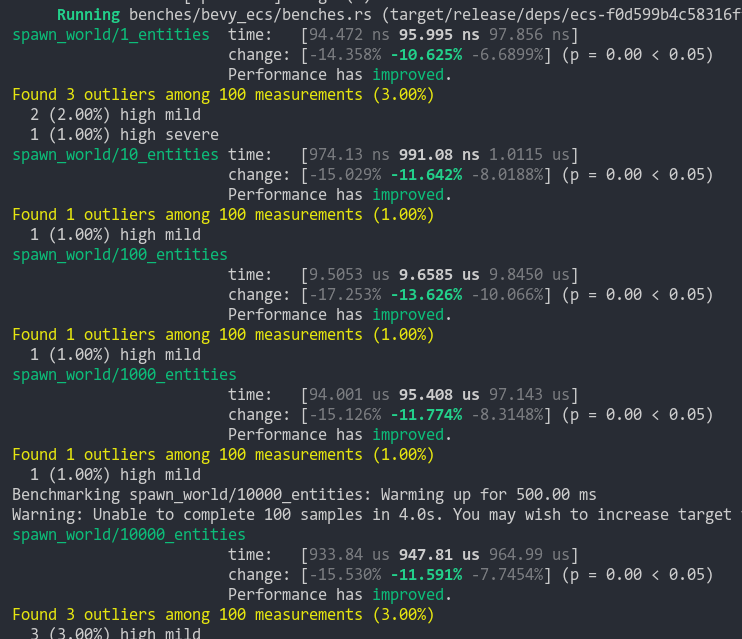
To take this measurement, I added a new `world_spawn` benchmark.
Unfortunately, optimizing `Commands::spawn` is slightly less trivial, as Commands expose the Entity id of spawned entities prior to actually spawning. Doing the optimization would (naively) require assurances that the `spawn(some_bundle)` command is applied before all other commands involving the entity (which would not necessarily be true, if memory serves). Optimizing `Commands::spawn` this way does feel possible, but it will require careful thought (and maybe some additional checks), which deserves its own PR. For now, it has the same performance characteristics of the current `Commands::spawn_bundle` on main.
**Note that 99% of this PR is simple renames and refactors. The only code that needs careful scrutiny is the new `World::spawn()` impl, which is relatively straightforward, but it has some new unsafe code (which re-uses battle tested BundlerSpawner code path).**
---
## Changelog
- All `spawn` apis (`World::spawn`, `Commands:;spawn`, `ChildBuilder::spawn`, and `WorldChildBuilder::spawn`) now accept a bundle as input
- All instances of `spawn_bundle` have been deprecated in favor of the new `spawn` api
- World and Commands now have `spawn_empty()`, which is equivalent to the old `spawn()` behavior.
## Migration Guide
```rust
// Old (0.8):
commands
.spawn()
.insert_bundle((A, B, C));
// New (0.9)
commands.spawn((A, B, C));
// Old (0.8):
commands.spawn_bundle((A, B, C));
// New (0.9)
commands.spawn((A, B, C));
// Old (0.8):
let entity = commands.spawn().id();
// New (0.9)
let entity = commands.spawn_empty().id();
// Old (0.8)
let entity = world.spawn().id();
// New (0.9)
let entity = world.spawn_empty();
```
 ickshonpe
