* SEND specialization. Adds 2 new specialized instructions:

* SEND_VIRTUAL: for sends to virtual iterators e.g lists and tuples
* SEND_ASYNC_GEN: for sends to async generators

Tweak FOR_ITER_VIRTUAL so that SEND_VIRTUAL and FOR_ITER_VIRTUAL use equivalent guards
The function__entry and function__return probes stopped working in Python 3.11
when the interpreter was restructured around the new bytecode system. This change
restores these probes by adding DTRACE_FUNCTION_ENTRY() at the start_frame label
in bytecodes.c and DTRACE_FUNCTION_RETURN() in the RETURN_VALUE and YIELD_VALUE
instructions. The helper functions are defined in ceval.c and extract the
filename, function name, and line number from the frame before firing the probe.

This builds on the approach from https://github.com/python/cpython/pull/125019
but avoids modifying the JIT template since the JIT does not currently support
DTrace. The macros are conditionally compiled with WITH_DTRACE and are no-ops
otherwise. The tests have been updated to use modern opcode names (CALL, CALL_KW,
CALL_FUNCTION_EX) and a new bpftrace backend was added for Linux CI alongside
the existing SystemTap tests. Line probe tests were removed since that probe
was never restored after 3.11.
Add a FRAME_SUSPENDED_YIELD_FROM_LOCKED state that acts as a brief
lock, preventing other threads from transitioning the frame state
while gen_getyieldfrom reads the yield-from object off the stack.
Now that the specializing interpreter works with free threading,
replace ENABLE_SPECIALIZATION_FT with ENABLE_SPECIALIZATION and
replace requires_specialization_ft with requires_specialization.

Also limit the uniquely referenced check to FOR_ITER_RANGE. It's not
necessary for FOR_ITER_GEN and would cause test_for_iter_gen to fail.
We didn't catch this because of a combination of:

1) falling through to the if-statement below works
2) we only specialized FOR_ITER_GEN for uniquely referenced generators,
   so we didn't trigger the non-thread-safe behavior.
* Halve size of buffers by reusing combined trace + optimizer buffers for TOS caching
* Add simple buffer struct for more maintainable handling of buffers
* Decouple JIT structs from thread state struct
* Ensure terminator is added to trace, when optimizer gives up
This makes generator frame state transitions atomic in the free
threading build, which avoids segfaults when trying to execute
a generator from multiple threads concurrently.

There are still a few operations that aren't thread-safe and may crash
if performed concurrently on the same generator/coroutine:

 * Accessing gi_yieldfrom/cr_await/ag_await
 * Accessing gi_frame/cr_frame/ag_frame
 * Async generator operations
* Factor out bodies of the largest uops, to reduce jit code size.
* Factor out common assert, also reducing jit code size.
* Limit size of jitted code for a single executor to 1MB.
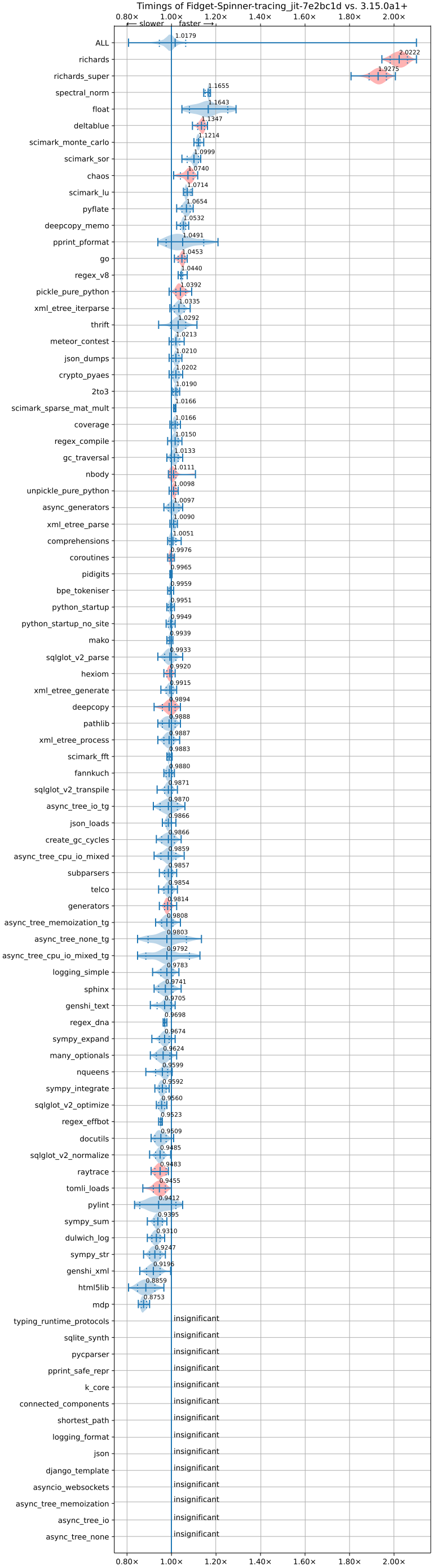
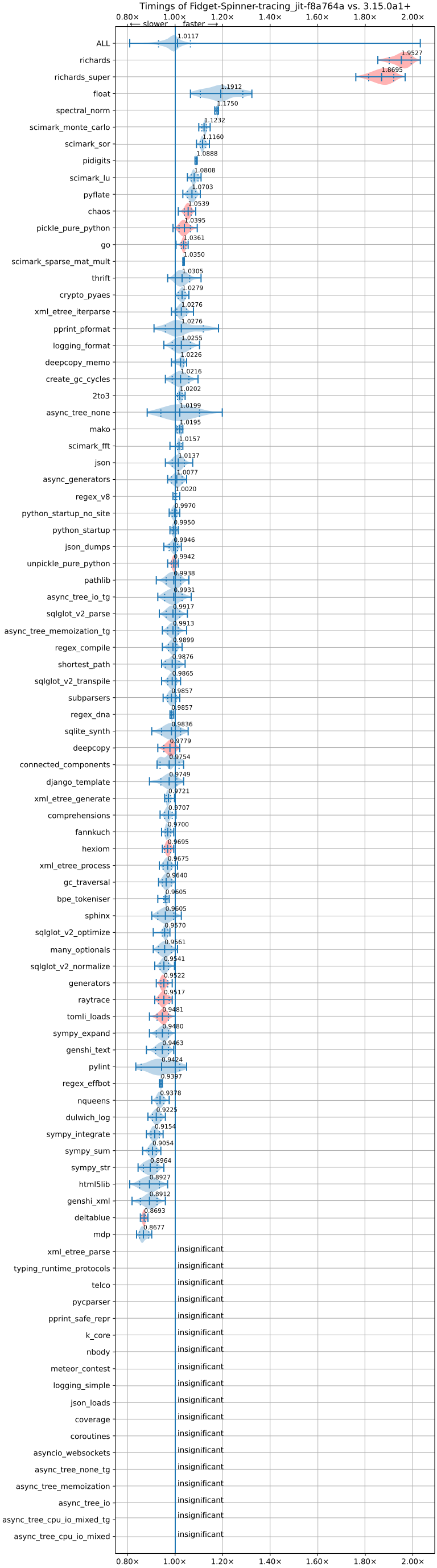
This PR changes the current JIT model from trace projection to trace recording. Benchmarking: better pyperformance (about 1.7% overall) geomean versus current https://raw.githubusercontent.com/facebookexperimental/free-threading-benchmarking/refs/heads/main/results/bm-20251108-3.15.0a1%2B-7e2bc1d-JIT/bm-20251108-vultr-x86_64-Fidget%252dSpinner-tracing_jit-3.15.0a1%2B-7e2bc1d-vs-base.svg, 100% faster Richards on the most improved benchmark versus the current JIT. Slowdown of about 10-15% on the worst benchmark versus the current JIT. **Note: the fastest version isn't the one merged, as it relies on fixing bugs in the specializing interpreter, which is left to another PR**. The speedup in the merged version is about 1.1%. https://raw.githubusercontent.com/facebookexperimental/free-threading-benchmarking/refs/heads/main/results/bm-20251112-3.15.0a1%2B-f8a764a-JIT/bm-20251112-vultr-x86_64-Fidget%252dSpinner-tracing_jit-3.15.0a1%2B-f8a764a-vs-base.svg

Stats: 50% more uops executed, 30% more traces entered the last time we ran them. It also suggests our trace lengths for a real trace recording JIT are too short, as a lot of trace too long aborts https://github.com/facebookexperimental/free-threading-benchmarking/blob/main/results/bm-20251023-3.15.0a1%2B-eb73378-CLANG%2CJIT/bm-20251023-vultr-x86_64-Fidget%252dSpinner-tracing_jit-3.15.0a1%2B-eb73378-pystats-vs-base.md .

This new JIT frontend is already able to record/execute significantly more instructions than the previous JIT frontend. In this PR, we are now able to record through custom dunders, simple object creation, generators, etc. None of these were done by the old JIT frontend. Some custom dunders uops were discovered to be broken as part of this work gh-140277

The optimizer stack space check is disabled, as it's no longer valid to deal with underflow.

Pros:
* Ignoring the generated tracer code as it's automatically created, this is only additional 1k lines of code. The maintenance burden is handled by the DSL and code generator.
* `optimizer.c` is now significantly simpler, as we don't have to do strange things to recover the bytecode from a trace.
* The new JIT frontend is able to handle a lot more control-flow than the old one.
* Tracing is very low overhead. We use the tail calling interpreter/computed goto interpreter to switch between tracing mode and non-tracing mode. I call this mechanism dual dispatch, as we have two dispatch tables dispatching to each other. Specialization is still enabled while tracing.
* Better handling of polymorphism. We leverage the specializing interpreter for this.

Cons:
* (For now) requires tail calling interpreter or computed gotos. This means no Windows JIT for now :(. Not to fret, tail calling is coming soon to Windows though https://github.com/python/cpython/pull/139962

Design:
* After each instruction, the `record_previous_inst` function/label is executed. This does as the name suggests.
* The tracing interpreter lowers bytecode to uops directly so that it can obtain "fresh" values at the point of lowering.
* The tracing version behaves nearly identical to the normal interpreter, in fact it even has specialization! This allows it to run without much of a slowdown when tracing. The actual cost of tracing is only a function call and writes to memory.
* The tracing interpreter uses the specializing interpreter's deopt to naturally form the side exit chains. This allows it to side exit chain effectively, without repeating much code. We force a re-specializing when tracing a deopt.
* The tracing interpreter can even handle goto errors/exceptions, but I chose to disable them for now as it's not tested.
* Because we do not share interpreter dispatch, there is should be no significant slowdown to the original specializing interpreter on tailcall and computed got with JIT disabled. With JIT enabled, there might be a slowdown in the form of the JIT trying to trace.
* Things that could have dynamic instruction pointer effects are guarded on. The guard deopts to a new instruction --- `_DYNAMIC_EXIT`.
Allow the --enable-pystats build option to be used with free-threading.  The
stats are now stored on a per-interpreter basis, rather than process global.
For free-threaded builds, the stats structure is allocated per-thread and
then periodically merged into the per-interpreter stats structure (on thread
exit or when the reporting function is called). Most of the pystats related
code has be moved into the file Python/pystats.c.
* Track the current executor, not the previous one, on the thread-state.

* Batch executors for deallocation to avoid having to constantly incref executors; this is an ad-hoc form of deferred reference counting.
The specialization only depends on the type, so no special thread-safety
considerations there.

STORE_SUBSCR_LIST_INT needs to lock the list before modifying it.

`_PyDict_SetItem_Take2` already internally locks the dictionary using a
critical section.
 Mark Shannon